

Buying a Florida rental home can trigger a future reassessment after the sale. The seller’s tax record offers useful history, but it may not predict your ownership costs.
For investors, Florida rental property taxes belong in the purchase analysis before the offer, especially for 2026 planning. Model the likely post-sale property tax bill by county, along with insurance, vacancy, management, repairs, and financing.
A clear plan helps you price the property honestly and avoid treating the seller’s current bill as a guaranteed future expense.
Key Takeaways
- Florida rental homes generally follow non-homestead rules, so buyers should not assume the seller’s homestead exemption, accumulated cap, or current tax bill will continue after the purchase.
- Model the likely post-sale property tax using the property’s assessed value, taxable value, and local millage rates rather than relying on the seller’s historic bill.
- Review the county property appraiser record, TRIM notice, tax bill, exemptions, and appeal deadlines to catch valuation or classification issues promptly.
- Florida has no personal state income tax, but rental owners still need to account for federal reporting, depreciation rules, and expenses such as insurance, repairs, management, and reserves.
- Short-term rentals may create additional sales tax, discretionary surtax, tourist development tax, registration, and filing obligations that vary by location.
Florida Rental Property Taxes After Purchase
Florida has no personal state income tax, which is welcome news for rental owners. That does not make a rental home tax-free. You may still owe county property taxes, federal income tax, and sales and use tax or other collection duties for short stays.
The main local charge is an ad valorem property tax, based on taxable value multiplied by local millage rates. The county property appraiser determines assessed value, while local taxing authorities set millage rates.
The county tax collector sends the property tax bill, usually in November. The bill reflects the parcel’s taxable value and the rates set by those local authorities.
Renters don’t pay the county bill directly. The owner owes it, although property taxes are naturally part of the rent and return calculation.

Rental Homes Use Non-Homestead Rules
A rental home is generally treated as non homestead property rather than a homesteaded primary residence. A primary residence may qualify for a homestead exemption and Florida’s save our homes cap. A property held for rental generally doesn’t receive that homestead benefit, and losing it can materially increase taxable value.
Eligible non-homestead residential property may receive Florida’s 10% assessment limitation for certain non-school levies. This is an assessment cap, not a 10% tax rate, and it doesn’t limit the school district portion of the bill. Eligibility can vary by parcel, so check the official county property appraiser records.
There is no separate rental property tax rate. The difference usually comes from losing homestead-related benefits and applying the relevant assessment rules. Rental homes, second homes, vacation homes, and vacant lots can all fall under non-homestead rules.
The Seller’s Bill May Not Be Your Bill
The seller may have owned the home for years and benefited from a lower assessed value. After ownership transfers, the county may assess the property closer to its current just value for the next tax year.
A tax proration at closing divides the current year’s bill. It does not protect you from a higher assessment after the purchase.
We recommend reviewing the official county property appraiser record, latest tax bill, exemptions, and recent sales before setting your expected annual tax expense. A low historic tax bill can make a listing look stronger than it will under new ownership.
Why the Purchase Price Changes the Tax Forecast
A purchase doesn’t automatically create an immediate new bill at closing. Florida property is assessed as of January 1, and the closing statement may prorate the current year’s bill between buyer and seller. That adjustment allocates the current bill, but it doesn’t lock in the seller’s assessed value.
If you buy after January 1, 2026, the closing documents may still reflect the seller’s 2026 assessment. The 2027 assessment will generally be the first January 1 tax roll affected by the change of ownership, and it may reflect a new just-value review. Confirm January 1 transactions and unusual ownership changes with the county before modeling the tax bill.
The appraiser determines just value using market evidence. A purchase price is important evidence, but it isn’t automatically the new assessed value.
A rental buyer generally can’t claim the seller’s homestead exemption on the purchased property. The buyer also doesn’t inherit the seller’s accumulated save our homes cap or portability benefit. Portability generally concerns moving a qualifying homestead benefit to another homestead, not attaching it to an investment rental. If you’re changing or replacing a homestead, verify eligibility and filing deadlines with the appraiser or a Florida tax professional.
Use an Address-Specific Estimate
Don’t rely only on a countywide tax percentage. Ask the property appraiser office how the current assessed value compares with the purchase price. Then model a conservative tax amount based on the home’s likely post-sale just value.
Start with a conservative post-sale just-value assumption. Where relevant, separate school and non-school taxable value. For a blended estimate, multiply estimated taxable value by the combined millage rate and divide by 1,000.
Compare the result with the seller’s current bill. Account for exemptions the rental will lose, and run a range because millage rates and assessments can change.
Also review operating expenses that are separate from the ad valorem bill:
- A pool may require cleaning, equipment inspections, and repairs.
- Waterfront homes can bring seawall, dock, irrigation, insurance, and storm-preparation costs.
- HOA dues, special assessments, and owner-paid lawn service reduce net income alongside taxes.
A higher tax forecast isn’t a reason to abandon every purchase. It’s a reason to see the true cost before you commit.
A Florida Landlord Tax Calendar
Property tax deadlines and federal filing tasks can feel disconnected. For 2026, we find it easier to treat them as one annual ownership routine.
| Timing | What to Review | Why It Matters |
|---|---|---|
| January 1, 2026 | County assessment snapshot and ownership status | January 1 generally controls the 2026 assessed value, exemptions, and taxable status. |
| By April 1, 2026 | File tangible personal property return, if required | Furniture, appliances, and business equipment may be reportable separately from the real estate. Requirements and exemptions can depend on asset value and county procedures. |
| August 2026 | TRIM notice | Review the proposed assessed value, exemptions, taxable value, millage rates, and taxes for each taxing authority. |
| Within 25 days of TRIM mailing | Assessment or exemption appeal petition | File promptly if you challenge the value, classification, or an exemption decision. |
| November 2026 through March 2027 | 2026 property tax bill and payment | The bill is generally mailed in November. Early payments may receive discounts, while unpaid taxes become delinquent after the applicable spring deadline, generally April 1, 2027. |
| Tax filing season | Schedule E records and depreciation support | Organized records make federal reporting far easier. |
Read the TRIM Notice Carefully
TRIM means Truth in Millage. This notice is proposed information, not the final bill. It shows the proposed assessed value, exemptions, taxable value, and millage rates. It also lists proposed taxes for each taxing authority.
Review the proposed millage rates for each authority, including any millage rate increase. Estimate how that change could affect your taxes.
If the assessed value, classification, or exemption decision appears wrong, don’t wait for the November bill. Florida generally allows 25 days after the TRIM mailing date to petition the value adjustment board. The mailing date and deadline printed on your notice control.
Contact the property appraiser office promptly to discuss the issue. That contact does not necessarily extend the petition deadline.
Keep closing documents, appraisal reports, repair estimates, photographs, and comparable sales records. These documents can support a review or petition.
For 2026, confirm filing requirements and discount schedules with your county’s official property appraiser and tax collector materials. Review Florida Department of Revenue guidance as well. A tax professional can provide individualized appeal, ownership structure, or filing advice.
Federal Reporting Still Applies to Rental Activity
Florida’s lack of a state income tax doesn’t remove your federal income tax reporting duty. Rental income tax still applies to taxable rental profits. Your result depends on rental income, allowable expenses, depreciation, personal use, ownership structure, and loss limits.
Most rental property owners use a Schedule E Form 1040 filing to report income and expenses, following the official Schedule E of Form 1040 format.
The IRS Residential Rental Property guidance is a reliable starting point for general information, not individualized tax advice. It covers income, expenses, personal use, records, and depreciation rules.
Some eligible rental activities may qualify for a Section 199A deduction tied to qualified business income. IRS requirements apply, and the deduction isn’t guaranteed for every owner.
Expenses That May Reduce Taxable Rental Income
Common expenses can include mortgage interest, property taxes, landlord insurance, property management fees, advertising, owner-paid utilities, lawn care, pest service, repairs, and maintenance. Property tax deductions depend on applicable federal limits and tax rules.
A deduction reduces taxable income. It doesn’t make an expense disappear. A $4,000 insurance bill still affects your cash flow, even if it may help reduce federal taxable income.
Keep rental funds separate from personal spending. Clear records make it easier to see which expenses belong to the property and which need further review.
Repairs and Improvements Follow Different Rules
The repair versus improvement distinction determines whether work may be deducted now or recovered over time. A minor plumbing repair, broken lock replacement, or drywall patch may be a current repair expense.
Work that adds value, extends useful life, or adapts the home for a new use may need to be capitalized. A new roof, full HVAC replacement, major remodel, or seawall project may be capital improvements. These costs generally must be capitalized and recovered over time, unlike routine maintenance. Save invoices, permits, contractor descriptions, and before-and-after photos.
Residential rental buildings are generally depreciated over 27.5 years under MACRS. This depreciation deduction can lower taxable income over time. Land isn’t depreciable, and mortgage principal isn’t a current rental deduction. A mortgage interest deduction may apply to qualifying interest, but depreciation doesn’t pay the mortgage or fund a storm repair.
Passive activity losses may limit rental losses, even when the property shows a paper loss. Current federal rules can change. A tax professional should review shared ownership, partnerships or LLCs, personal use, depreciation, Section 199A positions, and other complex facts.
Short-Term Rentals Create Additional Tax Duties
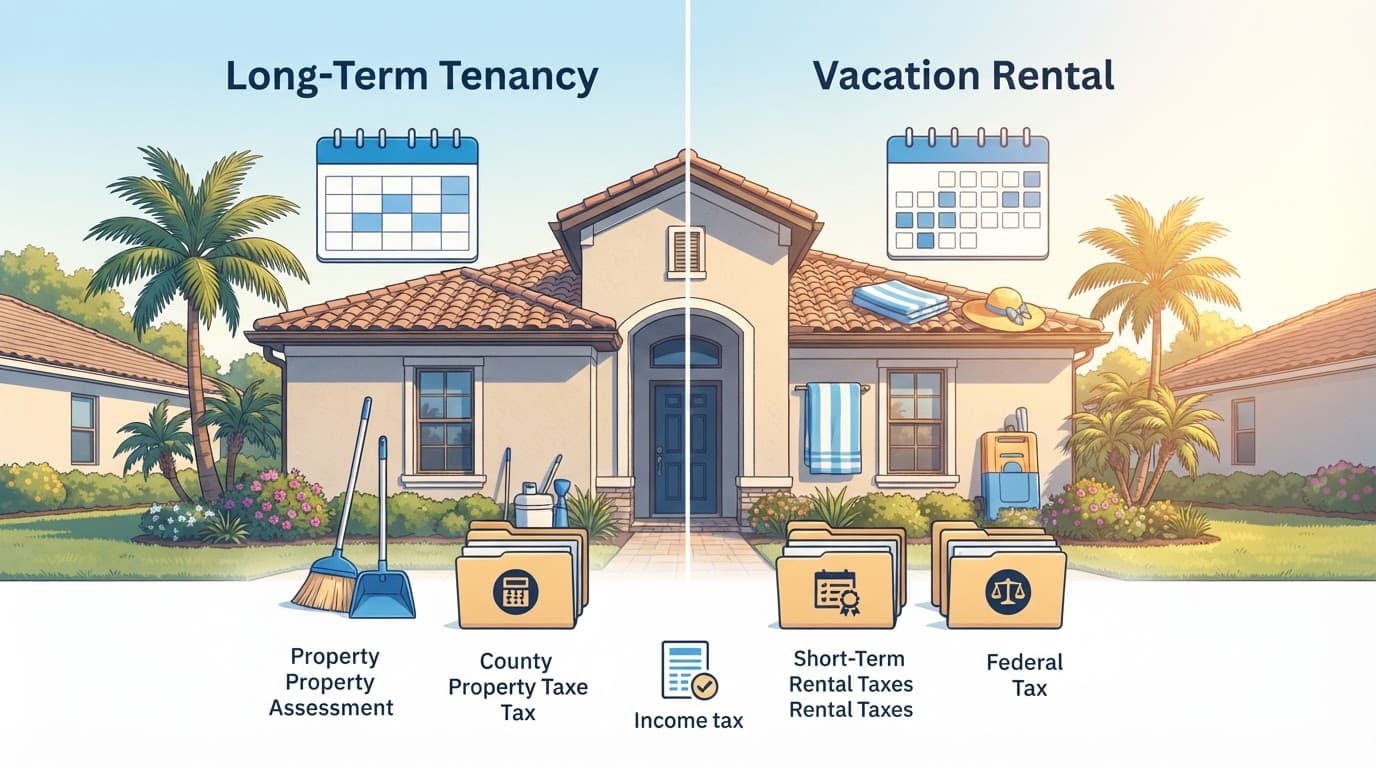
Long-term rentals usually offer more predictable occupancy and simpler monthly planning. Vacation rentals and other short term rentals may produce stronger gross income during busy seasons, but they also create more turnover, furnishing costs, cleaning, utilities, platform charges, and tax filings.
Rentals of Six Months or Less
Florida generally treats accommodations rented for six months or less as taxable transient rentals. Florida’s 6% sales tax applies to these rentals under the state’s sales and use tax system, and the applicable discretionary sales surtax may also apply.
Rates and collection rules can change, so review the Florida Department of Revenue’s current sales and use tax rules before listing the home.
A county tourist development tax is a separate local levy from state sales tax. Its rate and filing process vary by county. Florida’s local option tax information explains the state and local framework.
At the time of writing, Lee County’s tourist development tax page lists a 5% charge on gross rental amounts. This county example does not establish a statewide rate, so verify current requirements before pricing the rental.
Written Leases Matter
A bona fide written lease for more than six months is generally outside transient-rental treatment, but the facts and applicable exceptions matter. Simply labeling an arrangement a lease doesn’t determine its tax treatment.
Before advertising, confirm the lease term, payment records, and registration requirements. Also check filing and remittance duties, local business-tax receipts, zoning, HOA rules, and city and county restrictions.
Online booking platforms may collect some taxes in certain locations. That collection doesn’t automatically resolve every owner obligation. Confirm what the platform actually collects, who files and remits taxes, what remains your responsibility, and where filings must be made.
Build Taxes Into the Investment Model
Taxes belong in operating expenses, beside insurance and management. We calculate net operating income before debt service, then subtract principal, interest, and planned reserves to estimate pre-tax cash flow.
Consider this illustrative Lehigh Acres example: a $329,000 purchase with projected rent of $1,850 per month. Scheduled annual rent is $22,200, and a 5% vacancy allowance reduces effective rental income to $21,090.
For this illustration, the $4,100 property tax figure is a model input, not a Florida-wide rule. Estimated annual ad valorem tax equals estimated taxable value multiplied by the combined millage rate, divided by 1,000.
The forecast should use parcel-specific assessed value, taxable value, and millage information. A conservative model should use a post-purchase assessment, separately consider school and non-school taxes when relevant, and test higher millage or assessment values instead of copying the seller’s bill.
Using these illustrative inputs, annual operating expenses include $4,100 in taxes, $4,000 in insurance, and 10% management on effective rent, or $2,109 in property management fees. They also include about $1,055 for maintenance and $1,200 for lawn and pest care, producing estimated NOI of about $8,626 before reserves.
Set aside an illustrative $2,000 for planned reserves, leaving about $6,626 before debt service. With approximately $19,704 in annual principal and interest, pre-tax cash flow is negative by about $11,078 before reserves and $13,078 after reserves.
Federal deductions may reduce taxable income, but they don’t improve NOI or pay the mortgage.
Don’t Let Tax Savings Carry a Weak Deal
This example isn’t a rent forecast or a guarantee. It shows why a property can have tenants and still struggle after real ownership costs arrive.
A modest increase in annual insurance or taxes can reduce cash flow more than a small rent increase improves it. We run conservative, expected, and strong cases, changing rent, vacancy, repairs, insurance, financing, reserves, and tax assumptions.
Ask your lender for its written DSCR calculation. Some lenders compare NOI with annual debt service, while others use a rent-to-PITIA approach. The same property can produce different approval results under each method.
Keep Records That Support Better Decisions
Monthly owner statements should separately show collected rent, property management fees, repairs, invoices, insurance, tax payments, owner contributions, and deposits. Track security deposits separately because receiving them doesn’t usually make them rental income; treatment can change when a deposit is retained or applied. Keep closing statements, prior tax bills, TRIM notices, insurance declarations, repair invoices, permits, depreciation schedules, and lease records together. These documents help verify the tax forecast and support Schedule E reporting.
For Southwest Florida owners, storm costs deserve separate line items and reserve planning. Flood coverage, hurricane deductibles, roof repairs, pool equipment, irrigation, seawall work, and vacancy after a major event can change the numbers quickly. Document those costs carefully, without assuming every item is automatically deductible. Furnished rentals should also include inventories for furniture, appliances, and other tangible personal property.
Reliable records make tax time less stressful and reveal changes early. If a record or classification is unclear, check with the county property appraiser, tax collector, Florida Department of Revenue, IRS, or a qualified tax professional. If a manager handles the property, request clear accounting and supporting records through Best Investing Realty’s contact Southwest Florida property management experts page.
Frequently Asked Questions
Will my Florida rental property’s tax bill match the seller’s bill?
Not necessarily. A change in ownership may lead to a new assessment closer to the property’s current just value, and the rental generally will not receive the seller’s homestead benefits.
How are Florida rental property taxes estimated after a purchase?
Estimate the likely taxable value, apply the applicable county and local millage rates, and divide by 1,000. Use an address-specific, conservative forecast and separately consider school and non-school taxes when relevant.
When does a reassessment usually affect a purchased rental home?
Florida property is assessed as of January 1, and the first January 1 tax roll after a purchase may reflect the ownership change. Closing prorations allocate the current year’s bill but do not guarantee the seller’s assessed value for future years.
Do Florida rental owners owe federal income tax?
Yes. Florida’s lack of a personal state income tax does not eliminate federal reporting for rental activity. Owners commonly report rental income and expenses on Schedule E, subject to depreciation, personal-use, passive-loss, and other applicable rules.
Do short-term Florida rentals have additional taxes?
Generally, rentals of six months or less may be subject to Florida sales tax, discretionary sales surtax, and a separate county tourist development tax. Rates, collection duties, and filing requirements vary, so confirm current rules with the Florida Department of Revenue and the relevant local authorities.
Make the Tax Bill Part of the Buying Decision
Florida rental property taxes are manageable when you model the likely reassessment before closing. Verify the current parcel record and estimate the new taxable value and millage-based bill instead of relying on the seller’s history.
The strongest rental analysis also uses address-specific insurance quotes, realistic reserves, and achievable rent. Florida has no personal state income tax, but rental owners still face property-tax and federal-reporting obligations.
Tax deductions can improve your federal result, but they should never rescue a weak cash-flow deal. A dependable rental home still needs to carry operating costs, debt service, and future repairs.
This article provides general information only. Confirm exemption eligibility, reassessment timing, and transient taxes with the relevant Florida property appraiser, tax collector, or Florida Department of Revenue. Check federal deductions and ownership-specific consequences against IRS guidance or with a Florida tax professional.