
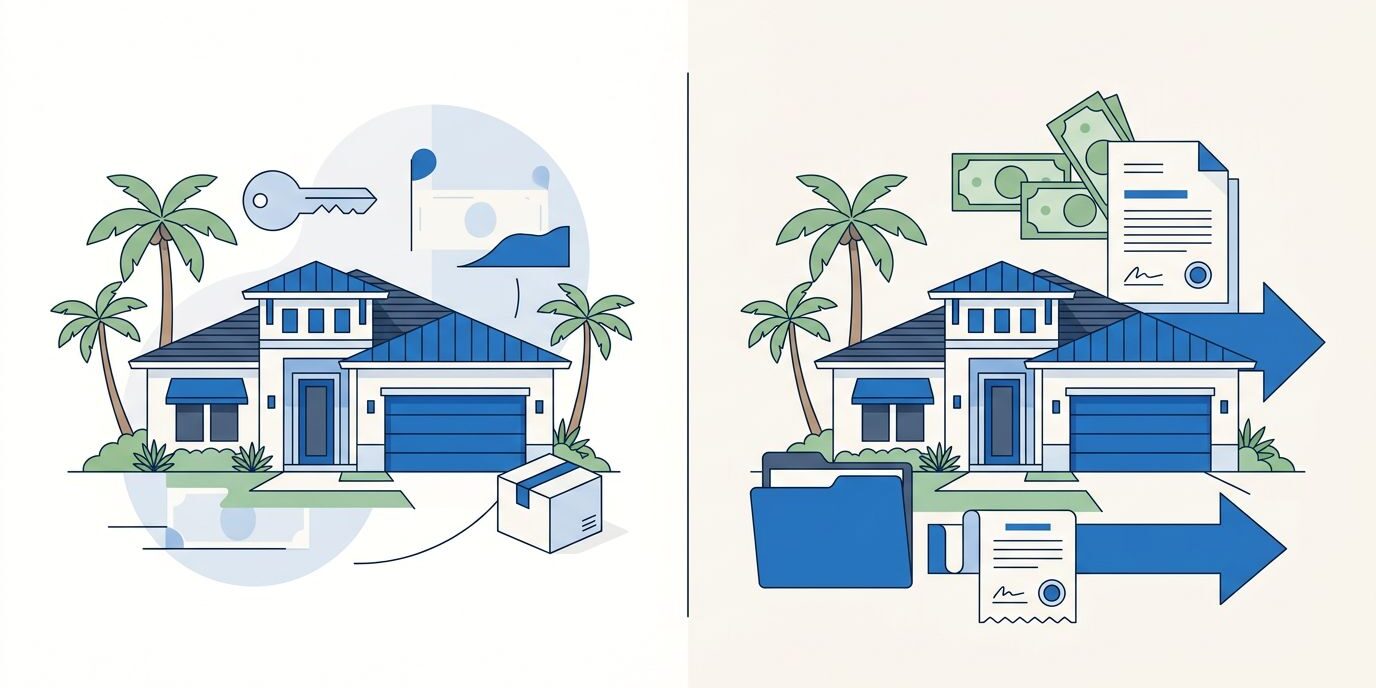
A newly built Florida home may look like an easy rental property. Strong finishes and a new roof don’t guarantee workable monthly cash flow. The rent or sell home decision is a real estate investment choice based on achievable rent, insurance, financing, and your planned holding period.
Selling may release funds for a down payment on your next purchase, while renting out a home may preserve your mortgage interest rate and create long-term income. Renting works only if the property remains financially workable after vacancy, repairs, reserves, and debt service. We start with the numbers before choosing a strategy.
Key Takeaways
- Decide whether to rent or sell based on verified numbers, including achievable rent, vacancy, insurance, taxes, management, repairs, reserves, debt service, and selling costs.
- Compare net sale proceeds with the rental property’s projected long-term value, and set a realistic holding period before choosing a strategy.
- Use conservative Southwest Florida rent and expense assumptions because new construction, competing inventory, concessions, and regional rental softness can reduce effective income.
- Review capital gains, depreciation, mortgage underwriting, and DSCR considerations before converting the home to a rental or purchasing another property.
- Renting is not automatically passive income; account for management responsibilities, legal compliance, maintenance risk, and a clear exit strategy.
Rent or Sell Home: Start With the Numbers
When comparing the two paths, selling creates net proceeds after the mortgage payoff and transaction costs. Holding creates operating income, equity growth, and ongoing responsibilities.

Compare Immediate Equity With Future Income
Begin with a realistic estimate of the net proceeds. Compare the current home value with the purchase price, then subtract the remaining mortgage, selling costs, real estate commission, title charges, recording fees, documentary stamp taxes, repairs, staging, concessions, prorated taxes, closing costs, and other expenses. The resulting amount, not the paper home equity, shows what can fund your next down payment.
Then calculate what the rental property could produce. Include rent, vacancy, maintenance, insurance, property taxes, lawn care, HOA dues, management, reserves, and debt service. Use the price-to-rent ratio as an initial screen for a real estate investment. It can’t replace realistic vacancy, expense, and financing assumptions. Property appreciation may occur even when the property produces negative cash flow.
A $40,000 gain in the property’s value doesn’t automatically outweigh several years of negative cash flow. We compare the expected annual return with the equity that could be used elsewhere.
Set the Holding Period Before Choosing
Rental ownership usually needs time. Early costs may include lease-up services, landscaping, blinds, appliances, reserve funding, and insurance adjustments. These costs can make the first year look weaker than later years.
If you may sell within 12 to 24 months, transaction costs deserve extra attention. If you expect to hold for seven years or longer, principal reduction and property appreciation may carry more weight.
Use a rent vs sell calculator to organize the comparison, not guarantee an outcome. Set your expected holding period before comparing strategies. This keeps short-term cash needs separate from a long-term rental forecast.
Build a Florida Rental Cash-Flow Model
Projected rent is only the starting point. We calculate collected rent, subtract operating expenses, then account for financing and planned reserves.

Separate Rent, Vacancy, NOI, and Cash Flow
Use this basic formula:
Cash flow = effective rental income – operating expenses – debt service – planned reserves
NOI comes before the mortgage payment and includes operating expenses such as taxes, insurance, management, maintenance costs, and lawn care. Cap rate uses NOI divided by the total acquisition cost. Cash flow goes one step further by including debt service and planned reserves.
Consider a Lehigh Acres investment property with a purchase price of $329,000, 25% equity, and projected rent of $1,850 monthly. Model a 30-year loan with a 7% mortgage interest rate.
| Annual Item | Amount |
|---|---|
| Scheduled rent | $22,200 |
| 5% vacancy allowance | -$1,110 |
| Effective rent collected | $21,090 |
| Taxes, insurance, management, maintenance, lawn care | -$12,464 |
| Estimated NOI | $8,626 |
| Principal and interest | -$19,704 |
| Maintenance reserve | -$1,055 |
| Estimated cash flow | -$12,133 |
This model isn’t a rent forecast or guarantee, and it produces roughly -$1,011 in monthly cash flow. It shows why management and reserves belong in the model before making an offer. The IRS rental property guidance also separates rental income and deductible expenses from the property’s pre-tax operating performance.
Price Insurance and Taxes for the Actual Address
New construction may reduce early repair risk, but it doesn’t guarantee lower insurance. Quotes depend on the roof, construction type, elevation, replacement cost, flood zone, wind mitigation features, pool, waterfront exposure, and coverage limits.
A landlord policy should address dwelling coverage, premises liability, landlord-owned contents, and loss of rent after a covered event. Flood damage generally requires separate coverage. Percentage-based hurricane deductibles need careful review. A 5% deductible on a $400,000 dwelling limit could mean $20,000 before insurance pays.
Florida TRIM notices generally arrive in August. A TRIM notice isn’t the tax bill, and the deadline to challenge an assessment is short, usually 25 days from mailing under the statewide framework. Review the county property appraiser’s records for the new assessment, exemptions, and reassessment risk.
Let Southwest Florida Demand Set the Rent
Rental assumptions should reflect the neighborhood, property type, and current competition. A newly built home in Lehigh Acres may compete with other new homes, while a Cape Coral property may compete based on pool, canal, or outdoor features.
Use Current Local Evidence
Late July 2026 RentCafe-based reporting placed average apartment rent at $1,873 in Naples, down 1.61% year over year, and $1,727 in Fort Myers, down 4.88%. A 2026 FGCU-linked regional report also showed real median rents declining across coastal counties, including Lee, Collier, and Charlotte. These July 2026 figures are dated evidence of softness in the regional real estate market, not a guaranteed current rent for a specific house.
Apartment figures aren’t a direct substitute for a single-family rental quote. For a rental property, compare recently leased homes with similar bedrooms, finishes, garages, communities, and amenities. A price-to-rent ratio is a rough screen, not a substitute for those comparable leases.
Budget for a longer lease-up period when nearby new construction adds competing inventory. Concessions and vacancy can reduce effective rental income, even when the advertised monthly figure remains unchanged.
Measure Features Against Their Cost
Pools, screened lanais, canal views, gulf access, and updated kitchens can strengthen tenant demand. They also add cleaning, equipment, irrigation, seawall, dock, insurance, and storm-preparation costs.
A feature helps the investment only when its added rent exceeds its added upkeep. We ask for separate estimates of maintenance costs. Those estimates should include pool service, lawn care, pest control, HVAC maintenance, seawall work, dock upkeep, and other waterfront work. Review them before counting the feature as a return advantage.
Compare Net Sale Proceeds With Holding Value
Selling a home may be the stronger choice when you need liquidity or want to reduce debt. It can also let you redirect home equity into another investment property or real estate investment. A sale can remove vacancy risk, management concerns, and Florida operating expenses.
Calculate What Selling Really Delivers
Ask a real estate agent for a comparative market analysis and seller net sheet. Then test the result against a conservative sale price. Include the mortgage payoff, selling costs, and closing costs. Repairs required by an inspection, buyer credits, rate buydown contributions, and days on market can reduce proceeds.
Selling may make sense when:
- You need the equity for another down payment or business purpose.
- The property produces negative cash flow under realistic assumptions.
- Insurance, taxes, HOA fees, or storm exposure weaken the return.
- You don’t want to manage a tenant or pay for professional management.
- The home has strong market demand and a reasonable after-cost profit.
A $400,000 listing is not a $400,000 decision. The useful figure is cash remaining after the loan payoff, selling costs, taxes, and your next investment need.
Protect the Timing of the Decision
A newly built home may have limited operating history, making a future sale attractive before the property requires major replacements. On the other hand, selling before stabilizing occupancy can leave value on the table if buyers discount an unproven rental.
Compare today’s home value with the expected equity after your planned holding period. Use a conservative property appreciation assumption, not a guaranteed annual increase. A rent vs sell calculator and price-to-rent ratio are only screening tools, so their results depend on the rent, vacancy, insurance, and tax assumptions entered.
Check Capital Gains and Depreciation Rules
Tax treatment can change the result, especially when a home moves from primary residence use to rental use. We keep tax projections separate from operating cash flow and confirm capital gains tax details with a qualified tax professional.
Review the Primary Residence Exclusion
Section 121 may allow eligible taxpayers a capital gains exclusion of up to $250,000, or up to $500,000 for certain married couples filing jointly. The usual ownership and use test requires the home to have been owned and used as your main home for at least two of the five years before the sale.
The two years don’t need to be continuous. A home bought as an investment property and never used as an owner-occupied home generally won’t qualify simply because it is newly built. The home-sale exclusion rules in Publication 523 provide the worksheet and eligibility details.
If you convert a former home into a rental, timing matters. The exclusion isn’t an unlimited exemption after years of rental use, and nonqualified-use rules can reduce the sheltered gain.
Track Depreciation From the First Rental Year
Rental owners generally depreciate the building, not the land. Depreciation taken, or depreciation that was allowable, can create taxable gain when the property is sold. Section 121 doesn’t erase depreciation recapture, so capital gains tax calculations still require careful review.
Converting a rental into a primary residence later may help with part of the gain if the ownership and use tests are met. It doesn’t make prior depreciation disappear. Tax guidance on converting a rental into a primary residence shows why the sale date, occupancy history, and depreciation records matter.
Keep closing documents, improvement receipts, depreciation schedules, rental dates, and records of selling expenses. These details help your tax professional calculate adjusted basis correctly.
Plan for the Next Mortgage Before Keeping the First
Buying another home before selling or renting the newly built rental property can create a financing problem. Many owners assume projected rental income will offset the existing mortgage payment, but lenders may not give full credit without documentation.
Understand Concurrent Mortgage Underwriting
Lenders usually count the existing mortgage, property taxes, insurance, and association dues in your debt-to-income calculation. Income from the property may be considered only when the lender’s program permits it and is supported by a signed lease, rent schedule, tax history, or other required records. Qualification can also change as interest rates move.
A newly converted rental with no history may receive limited credit or no credit for projected rent. Your new mortgage could then be evaluated as if the first obligation still falls entirely on your personal income.
Before making an offer on the next home, ask the lender for a written estimate showing how the existing property will be treated. Use a rent vs sell calculator as a supplement, not a replacement for that estimate. Also confirm reserve requirements, lease documentation, and whether the loan is conventional, FHA, VA, USDA, or another program.
Use DSCR Carefully
Debt service coverage ratio compares property income with annual debt service. A common formula is:
DSCR = NOI / annual debt service
Some residential programs use a different calculation based on monthly rent and PITIA, which includes principal, interest, taxes, insurance, and association dues. Common lender targets may fall around 1.0 to 1.25, but requirements differ.
A property with $8,626 in NOI and $19,704 in annual debt service produces a ratio below 0.50 before certain reserves. That property may have tenants and still fail a coverage test. Ask for the lender’s written calculation before treating a financing quote as final.
Price the Work, Risk, and Exit Strategy
Renting out a home isn’t automatically passive income. A rental property needs reliable systems for landlord duties, tenant screening, leases, rent collection, inspections, maintenance, accounting, and legal compliance.
Compare Self-Management With Full Service
Self-management can reduce direct fees for a nearby owner with time, experience, and dependable vendors who help control maintenance costs. Software doesn’t respond to a weekend leak, inspect an air conditioner, document a condition issue, or coordinate an emergency repair.
A full-service property management fee commonly falls within 8% to 12% of collected monthly rent. Flat-fee plans may run roughly $100 to $300 per unit. On $1,850 in rental income, 8% equals $148, 10% equals $185, and 12% equals $222.
Review whether the fee applies to rent due or rent received. Confirm placement, renewal, setup, inspection, maintenance markup, advertising, eviction coordination, and after-hours charges. A lower percentage may cost more over a year if leasing and vendor charges are separate.
Consider a Managed Lease or Rent-to-Own Exit
A middle path can provide time to stabilize the property before selling. You might lease the home for a defined period, document actual rent and expenses, then reassess the sale after occupancy is established.
Rent-to-own arrangements and land contracts require careful legal drafting. A rent-to-own agreement may give the tenant an option to buy later. A land contract can involve installment payments, with the seller retaining title until completion. These structures carry different risks involving defaults, repairs, financing, insurance, and compliance.
We recommend using a Florida real estate attorney for the documents and a property manager for screening, inspections, rent collection, and records. The right structure is the one that remains workable when rent softens, repairs arrive, or the sale takes longer than expected.
Frequently Asked Questions
Is it better to rent or sell a newly built Florida home?
The better choice depends on net sale proceeds, realistic rental cash flow, tax consequences, financing needs, and your planned holding period. Renting may preserve a favorable mortgage rate and build equity, while selling may provide liquidity and eliminate operating risk.
What expenses should be included when calculating rental cash flow?
Include vacancy, property management, insurance, property taxes, HOA dues, lawn care, maintenance, reserves, and mortgage debt service. For Florida properties, also review flood coverage, hurricane deductibles, pool costs, seawall or dock maintenance, and storm-preparation expenses when applicable.
Can projected rent help me qualify for another mortgage?
Possibly, but lenders may limit or reject projected rental income when the property has no lease or rental history. Ask the lender for a written calculation showing how the existing mortgage, taxes, insurance, association dues, reserves, and rental income will be treated.
What tax issues arise when converting a home into a rental?
A conversion can affect eligibility for the primary residence capital gains exclusion, and depreciation taken or allowed may create taxable gain when the property is sold. Keep records of the purchase, improvements, rental dates, depreciation, and selling expenses, and review the details with a qualified tax professional.
Should I manage the rental myself or hire a property manager?
Self-management may reduce fees if you have the time, experience, and reliable vendors to handle tenant and maintenance issues. Full-service management commonly costs about 8% to 12% of collected rent, but you should also review leasing, renewal, inspection, maintenance markup, and after-hours charges.
Conclusion
The answer to whether to keep or sell a newly built Florida home comes down to verified numbers and your intended holding period. Compare net sale proceeds with monthly cash flow after vacancy, management, insurance, taxes, repairs, reserves, and debt service.
Southwest Florida’s current rental softness reflects a cautious real estate market, making conservative assumptions especially important. Before keeping the home, confirm how the next lender will treat expected lease revenue, review tax and depreciation rules, and choose an operating plan that protects your time and return.
The strongest decision isn’t the one with the highest projected rent. It’s the one that still works after real costs are included. A rent vs sell calculator can organize the comparison. Its result depends on the inputs, and a price-to-rent ratio is only a screening measure.