

For Florida real estate investors, an investment property can look profitable until insurance bills, taxes, vacancy, and debt service take their share. Rental income is only one part of the qualification analysis.
DSCR financing focuses on property income and debt coverage, which may fit a long-term rental. Conventional financing gives more weight to your personal income, debts, assets, and agency rules. Both can fund a strong investment, but coastal insurance bills or short-term rental restrictions require more than a favorable rent estimate. We start with the lending difference, then test the numbers Florida ownership creates.
Key Takeaways
- DSCR loans qualify primarily through a property’s rental income and debt coverage, while conventional loans place greater weight on personal income, debt-to-income ratio, assets, and agency rules.
- Florida taxes, insurance, vacancy, HOA dues, maintenance, and storm-related costs can materially reduce NOI and change whether a property meets a lender’s DSCR requirement.
- DSCR programs may offer more flexibility for self-employed investors or borrowers whose tax returns understate income, but they often involve higher rates, larger costs, reserve requirements, or prepayment penalties.
- Conventional financing can provide lower pricing when the borrower has strong documented income, credit, reserves, and rental documentation.
- Short-term rental income may support financing only when lender policy, local regulations, licensing, insurance, HOA rules, and realistic seasonal performance all align.
DSCR Loans Florida vs. Conventional Loans: The Core Difference
Both products may finance the same investment property, but they judge the borrower differently. A DSCR loan asks whether property income supports the payment. A conventional loan asks whether documented personal finances meet agency requirements.
Property Income Qualifies a DSCR Loan
Debt Service Coverage Ratio measures the property’s available income against its debt obligation. Lenders may review the lease or market rent, then compare rental income with taxes, insurance, HOA dues, and the proposed payment. A ratio of 1.0 means the income covers the obligation, while many programs prefer 1.20 to 1.25.
Personal income may receive less weight, which can help self-employed investors whose tax returns reduce qualifying income through depreciation. That doesn’t mean there is no underwriting. Credit score, reserves, property condition, liquidity, and the appraisal process still matter.

Personal Finances Qualify a Conventional Loan
Conventional underwriting reviews pay records, tax returns, bank statements, debts, credit, assets, and other financial documents as part of income verification. Lease income can help, but agency documentation and calculation rules apply to debt-to-income ratios and monthly debt obligations.
Strong borrowers may receive lower rates and established 30-year terms. Multiple mortgages, variable income, recent self-employment, or large tax deductions can make approval harder, even when the rental itself looks sound.
How Lenders Calculate DSCR in Florida
The Debt Service Coverage Ratio, or DSCR, uses the familiar formula:
DSCR = net operating income / annual debt service
Some residential DSCR programs use monthly rent divided by PITIA, meaning principal, interest, taxes, insurance, and association dues. Others use a rent schedule and expense assumptions. We ask for the lender’s written calculation before treating a quote as final, because the same property can show a different ratio under each method.
A Lehigh Acres Example
Consider a Lehigh Acres property priced at $329,000, with projected rent of $1,850 per month, 25% down, and an illustrative 30-year loan at 7%. Annual scheduled rent is $22,200. After a 5% vacancy allowance, effective rental income is $21,090.
The model assigns $4,100 to property taxes, $4,000 to insurance costs, $2,109 to management, $1,055 to routine maintenance, and $1,200 to lawn and pest service.
Those assumptions produce $8,626 in net operating income before financing.
Against approximately $19,704 in annual principal and interest, the coverage test compares that figure with annual debt obligations, producing NOI coverage of only 0.44. If those expenses are added to the denominator, coverage falls further. The property would not meet a lender seeking a 1.0 to 1.25 DSCR under those assumptions.
This isn’t a statewide rent forecast. It is a useful warning: a property can have tenants and still fail the loan’s coverage test.
Expense Lines That Belong in the Model
We separate vacancy from repairs, then include management, leasing fees, HOA dues, owner-paid utilities, lawn and pool service, capital reserves, flood coverage, and storm-related costs.
NOI comes before financing. Cash flow comes after debt service and planned reserves. A dependable analysis uses current tax records, an address-specific insurance quote, and rent evidence from comparable homes. Advertised rent alone cannot carry the decision.
Conventional Loans for Florida Investment Properties
Conventional loans are often the first choice when the borrower has clean, documentable income and wants agency pricing. They can fit an investment property well, especially when it produces dependable rent and the buyer has enough liquidity.
Agency Standards and Lender Overlays
Fannie Mae’s current eligibility matrix shows up to 85% loan-to-value for a one-unit investment-property purchase. That implies a 15% minimum down payment under the agency baseline, but it doesn’t guarantee a specific loan amount or final approval. A lender may require 20% or 25% through its own overlay.
Fannie Mae’s reserve requirements call for six months of cash reserves for an investment-property transaction, with additional reserves tied to other financed properties. Its multiple-financed-property guidance allows up to 10 financed properties under Desktop Underwriter, subject to the complete underwriting rules.
Rental income also needs support through approved documentation, such as a lease or appraisal rent schedule. Agency rules and lender overlays should be confirmed before you rely on quoted upfront costs or liquidity figures.
When Conventional Financing Fits
The strongest case is a borrower with stable W-2 or self-employed income, manageable debts, a high credit score, and liquidity beyond closing requirements. A lower rate can improve monthly cash flow, and conventional financing may provide predictable refinance and amortization options.
The trade-off is documentation. A borrower can own a profitable rental and still face difficulty if personal income is inconsistent or existing mortgages push the debt-to-income ratio too high.
DSCR Loan Requirements and Trade-Offs
The phrase DSCR loans Florida covers several lender programs, not one standard product. Most are non-QM loans for real estate investors, designed to finance rental investment property rather than a primary residence.
Typical Qualification Profile
Many programs start around a 620 credit score, require a 20% to 25% down payment, and look for a DSCR between 1.0 and 1.25. Some allow a lower ratio when the borrower contributes more cash, accepts a higher rate, or maintains larger reserves.
These are common program ranges, not universal requirements. The lender may request an appraisal, rent schedule, signed lease, insurance evidence, entity documents related to LLC ownership when applicable, bank statements, and a personal guarantee.
The appeal is less reliance on W-2s and tax returns for income verification, not a complete waiver of financial review. A new investor still needs defensible rent, acceptable property condition, and enough liquidity to handle vacancies and repairs.
Pricing, Prepayment, and Portfolio Limits
The flexibility can carry higher interest rates, larger closing costs, or prepayment penalties. Review whether those charges apply for three, five, or more years, and whether they affect a sale or cash-out refinance.
There is no single nationwide DSCR property limit. Each lender sets its own cap, and some limit total exposure, property count, loan amount, or short-term rental use. Flexible qualification may support portfolio scalability, but only when liquidity and property performance remain sound. Before adding another property, confirm how the new payment affects your cash reserves, debt obligations, and overall portfolio.
Florida Insurance and Property Taxes Can Change the Answer
Florida ownership costs deserve their own underwriting review. A single renewal cycle may bring relief, but insurance costs still require an address-specific quote, especially in coastal and Southwest Florida markets.
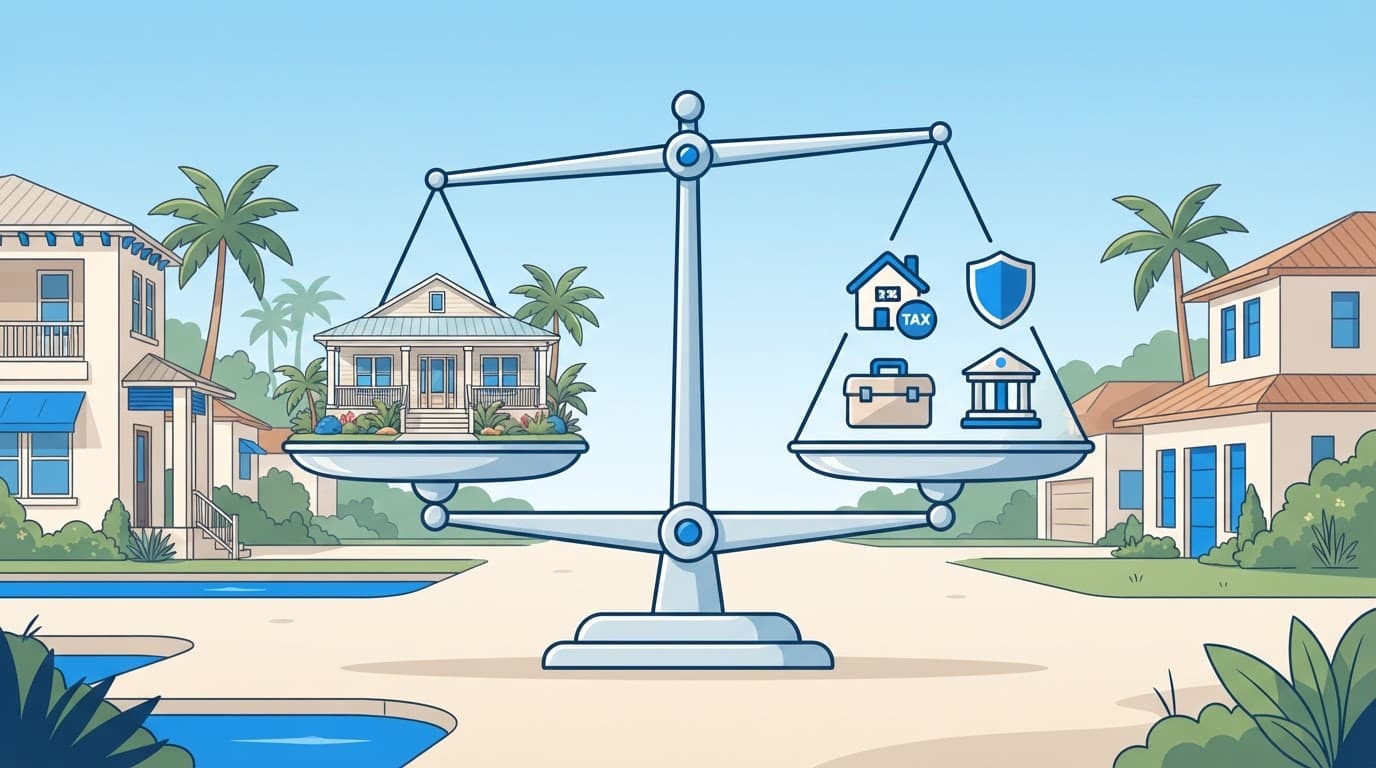
The governor’s 2026 Citizens insurance update reported an average 8.7% rate reduction for Citizens policyholders beginning with spring renewals. The Florida Office of Insurance Regulation’s stability report also tracks insurer performance and market conditions.
A statewide trend still cannot price a specific home in Lee, Collier, Miami-Dade, or Monroe County.
Insurance Is More Than the Premium
We model dwelling coverage at estimated replacement cost, not market value. We also review loss-of-rent coverage, premises liability, other structures, landlord-owned contents, ordinance or law coverage, and useful endorsements.
Water backup, service-line damage, equipment breakdown, pools, pets, docks, and seawalls may need separate attention. Flood damage is generally separate from standard property insurance.
Hurricane and roof deductibles can be percentage-based. A 5% hurricane deductible on a $400,000 dwelling limit would mean $20,000 out of pocket. Tenants need renters insurance for their belongings and personal liability.
Taxes Need a Fresh Review
A seller’s current tax bill may not reflect the county assessment after purchase. We review county property appraiser records, reassessment risk, exemptions, HOA dues, and planned improvements before using that figure in a DSCR calculation.
A small annual increase in taxes or insurance can reduce cash flow more than a modest rent increase improves it. That is why actual quotes belong in the financing model before an inspection or financing contingency is removed.
Short-Term Rentals and Eligible Florida Properties
Can DSCR loans finance Florida vacation properties? Often, yes, but approval depends on lender policy, the appraisal process, operating history, and whether the proposed use is legal at that address.
Financing Vacation-Rental Income
Short-term rental income can look impressive during peak season, then weaken during slower months. Furnishings, utilities, cleaning, platform fees, management, tourist taxes, repairs, and turnover reduce what the property produces.
We model occupancy by season instead of using the best monthly rate. Some DSCR lenders accept short-term rental projections or market data. Others want a lease, operating history, or a lower income figure.
Conventional underwriting can also consider projected revenue, but the documentation may be less flexible for a new vacation-rental strategy. Ask how the lender will treat projected revenue before making an offer.
State Licensing and Local Rules
Florida’s DBPR vacation rental guide explains state licensing requirements for qualifying vacation rentals. That is only the first review.
Cities and counties may add registration, business-tax, occupancy, parking, noise, safety, or inspection rules. HOA documents can create another restriction, even when state and local rules permit the use.
A property that cannot legally operate as a vacation rental cannot support a DSCR forecast based on vacation-rental income. Confirm the license path, local rules, taxes, insurance, and lease restrictions in writing.
Matching Properties to the Loan
A Florida investment property may include a single-family home, townhome, condo, or two- to four-unit residential property, but lender policy, appraisal results, HOA rules, and local-use requirements must align. Five or more units usually move into commercial financing rather than a standard residential DSCR product.
In Lehigh Acres, Cape Coral, Fort Myers, Punta Gorda, Port Charlotte, and Lake Placid, we compare a long-term rental’s achievable performance with vacation-rental projections. Taxes, insurance, maintenance, vacancy, and tenant demand shape the estimate. Miami, Orlando, Tampa, Jacksonville, and the Keys require market-specific assumptions for rent, taxes, insurance, HOA costs, maintenance, vacancy, and local regulations.
Choosing Between DSCR and Conventional Financing
For real estate investors comparing an investment property, use the comparison below as a starting point. Confirm the lender’s written terms for conventional loans and DSCR financing.
| Review Point | DSCR Loan | Conventional Loan |
|---|---|---|
| Main qualification | Property rental income and coverage | Borrower income, DTI, debt obligations, assets, and property |
| Income documents | Often less reliance on W-2s and tax returns | Extensive personal and rental-income documentation |
| Down payment | Commonly 20% to 25% | Fannie Mae baseline can be 15% for one-unit purchase |
| Ratio test | Often 1.0 to 1.25, program-specific | DTI and agency rental-income rules |
| Interest rates | Often higher | Often lower, depending on borrower and property profile |
| Short-term rental use | Depends on lender and legality | Depends on documentation and lender policy |
| Loan amount and limits | Set by lender and property profile | Agency loan limits and reserve rules apply |
| Portfolio limits | Lender-specific | Agency limits and reserve rules apply |
Build a Three-Case Decision
Choose DSCR when the rent is strong, personal-income documentation is the obstacle, and the higher financing cost still leaves acceptable cash flow. Choose conventional financing when your income, DTI, reserves, and rental documentation are strong enough to earn better pricing on a long-term rental.
We run conservative, expected, and strong cases for rent, vacancy, insurance, repairs, rates, and occupancy. If the property works only with peak rent and a low insurance quote, the financing choice isn’t the main problem. The purchase price or rental strategy needs another review.
Frequently Asked Questions
What is a DSCR loan in Florida?
A DSCR loan is an investment-property loan that focuses on whether rental income can support the property’s debt obligations. Personal income and tax returns may receive less emphasis, but credit, reserves, property condition, appraisal results, and liquidity still matter.
How much down payment is typically required for a Florida DSCR loan?
Many DSCR programs require a 20% to 25% down payment, although some allow different terms based on the coverage ratio, interest rate, or reserve position. Requirements vary by lender, property type, loan amount, and borrower profile.
Can a DSCR loan finance a Florida short-term rental?
Often, but approval depends on the lender’s policy, the appraisal, operating history, and whether the rental is legal at that address. Licensing, local rules, HOA restrictions, insurance, seasonal occupancy, platform fees, and other operating costs should be confirmed before relying on projected vacation-rental income.
Is a DSCR loan better than a conventional loan for a Florida rental?
Neither option is better for every investor. Conventional financing may offer lower pricing for a borrower with strong documented income and reserves, while DSCR financing may fit when the property produces dependable rent but personal-income documentation makes conventional approval difficult.
Choosing the Loan That Protects Cash Flow
The comparison between DSCR financing and traditional loans isn’t only about qualifying with fewer documents. It is about whether an investment property can support its payment and maintain cash flow after taxes, insurance, vacancy, maintenance, reserves, and local rental rules are included.
Conventional financing can offer lower pricing for a well-qualified borrower. DSCR financing can offer flexibility when the property produces dependable income but personal tax returns don’t show the full financial picture.
At Best Investing Realty, we help real estate investors compare achievable rent, current ownership costs, and day-to-day management needs before financing. A Florida investment becomes more dependable when the numbers work without perfect occupancy.