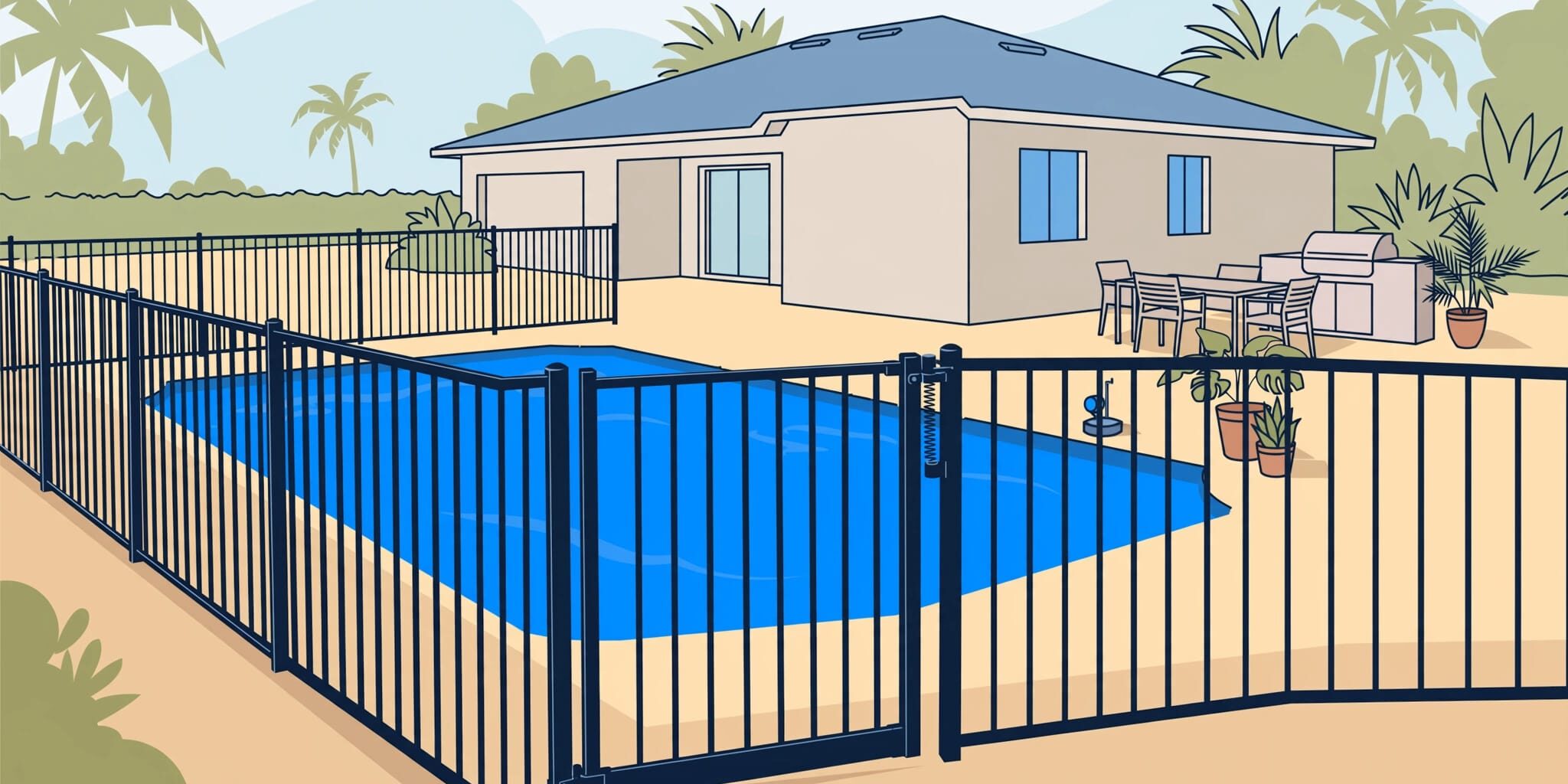
For a new qualifying residential pool, Florida law requires at least one approved safety feature before final inspection. The current statute lists five options, including an independently certified pool alarm.
For rental owners, choosing an option is only the beginning. Reliable maintenance, clear lease expectations, and dependable records help protect residents and your investment.
Start with the property’s classification and layout, then choose protection you can maintain throughout the tenancy.
Key Takeaways
- A qualifying new residential pool must have at least one of Florida’s five approved safety features before final inspection and a certificate of completion.
- The options are an isolation barrier, an ASTM F1346-91 safety cover, exit alarms on all direct-access doors and windows, self-closing and self-latching doors, or an in-pool alarm independently certified to ASTM F2208.
- Chapter 515 excludes several pool types, and local rules may be stricter. Check applicable requirements with the relevant local authority.
- Rental owners should keep approval and equipment records, maintain safety devices, and explain pool responsibilities to residents. Two inspections per year are a planning baseline for many long-term rentals, not a statewide requirement.
Understand Which Pool Safety Rules Apply
Florida’s Residential Swimming Pool Safety Act, Chapter 515, establishes residential pool safety options, barrier requirements, and penalties. A qualifying new pool needs at least one approved feature to pass final inspection and receive a certificate of completion.
Residential Rentals, Pools, and Spas
The residential definition includes detached one- or two-family dwellings and one-family townhouses no more than three stories high. Ordinary long-term tenant occupancy doesn’t, by itself, remove a qualifying home from the law.
The pool definition includes structures holding water more than 24 inches deep, including aboveground pools, hot tubs, and nonportable spas. The statute defines a young child as someone under six.
Exemptions and Different Property Types
Chapter 515 excludes public pools, pools at public lodging establishments, and pools at condominium, cooperative, or multifamily residential buildings. It also exempts qualifying temporary pools that cannot exceed 24 inches in depth and spas with compliant safety covers.
An exemption from Chapter 515 doesn’t eliminate other safety obligations. Florida’s public swimming pool requirements address a separate regulatory category.
Compare the Five Approved Safety Options
Which feature fits your rental? The answer depends on the home’s access points, pool layout, and maintenance demands.
These are the five options in the current statute.
| Safety Feature | Required Specification | Practical Fit |
|---|---|---|
| Isolation barrier | Compliant enclosure separating the pool from the home | Yards with room for a dedicated pool enclosure |
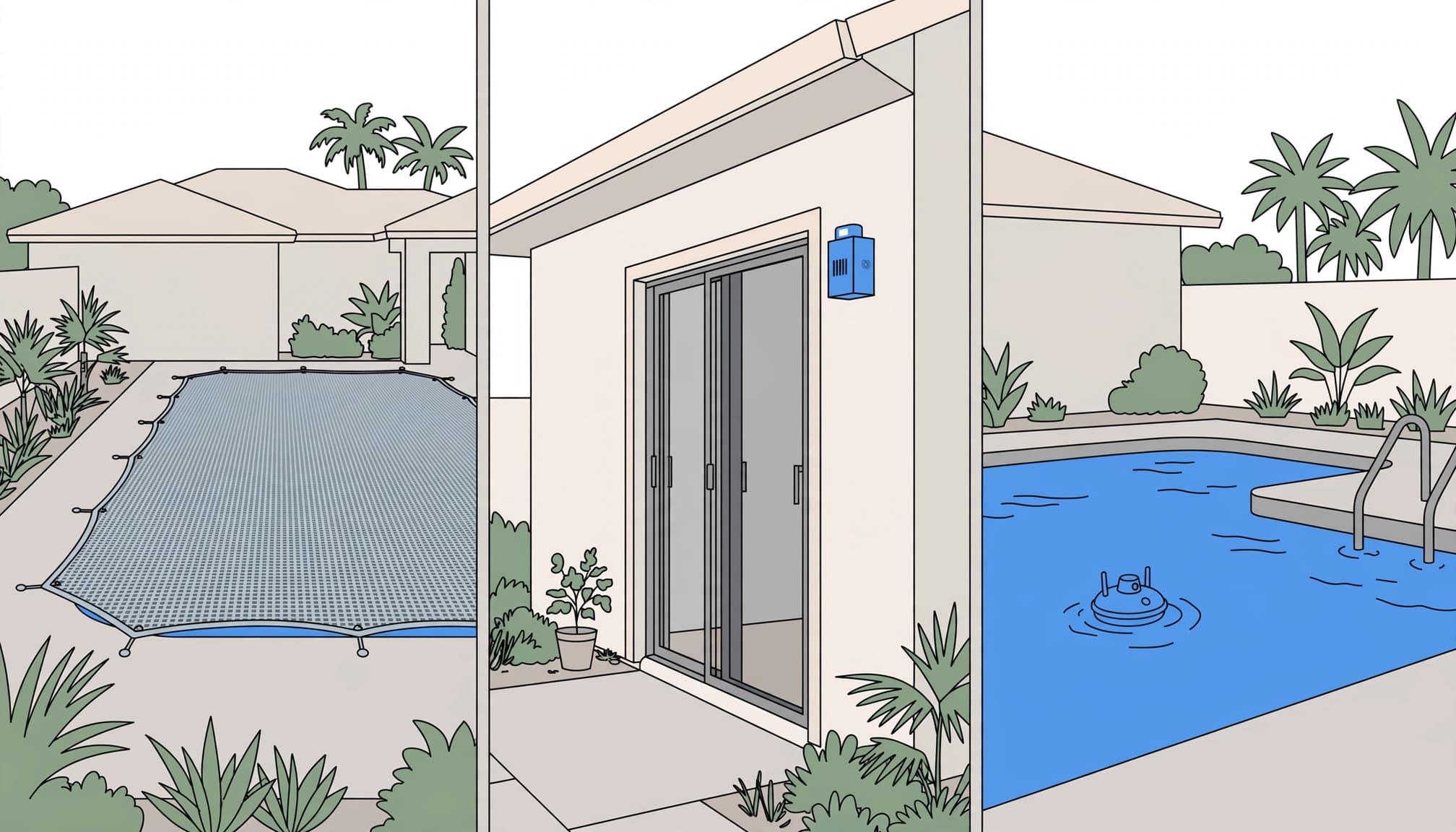
| Safety pool cover | Meets ASTM F1346-91 | Pools suited to a fitted manual or powered cover |
| Exit alarms | All direct-access doors and windows; 85 dB(A) at 10 feet | Homes with manageable access points |
| Self-closing, self-latching doors | All direct-access doors; release at least 54 inches above the floor | Layouts suited to automatic door hardware |
| Pool alarm | Independent ASTM F2208 certification | Pools compatible with an approved entry-detection device |
One approved option satisfies Chapter 515’s safety-feature requirement, but additional layers provide protection if equipment fails or someone leaves access unsecured.
We recommend weighing everyday reliability alongside installation cost. A feature that residents routinely disable creates an ongoing safety concern, even when it was approved at completion.
Step 1: Evaluate an Isolation Barrier
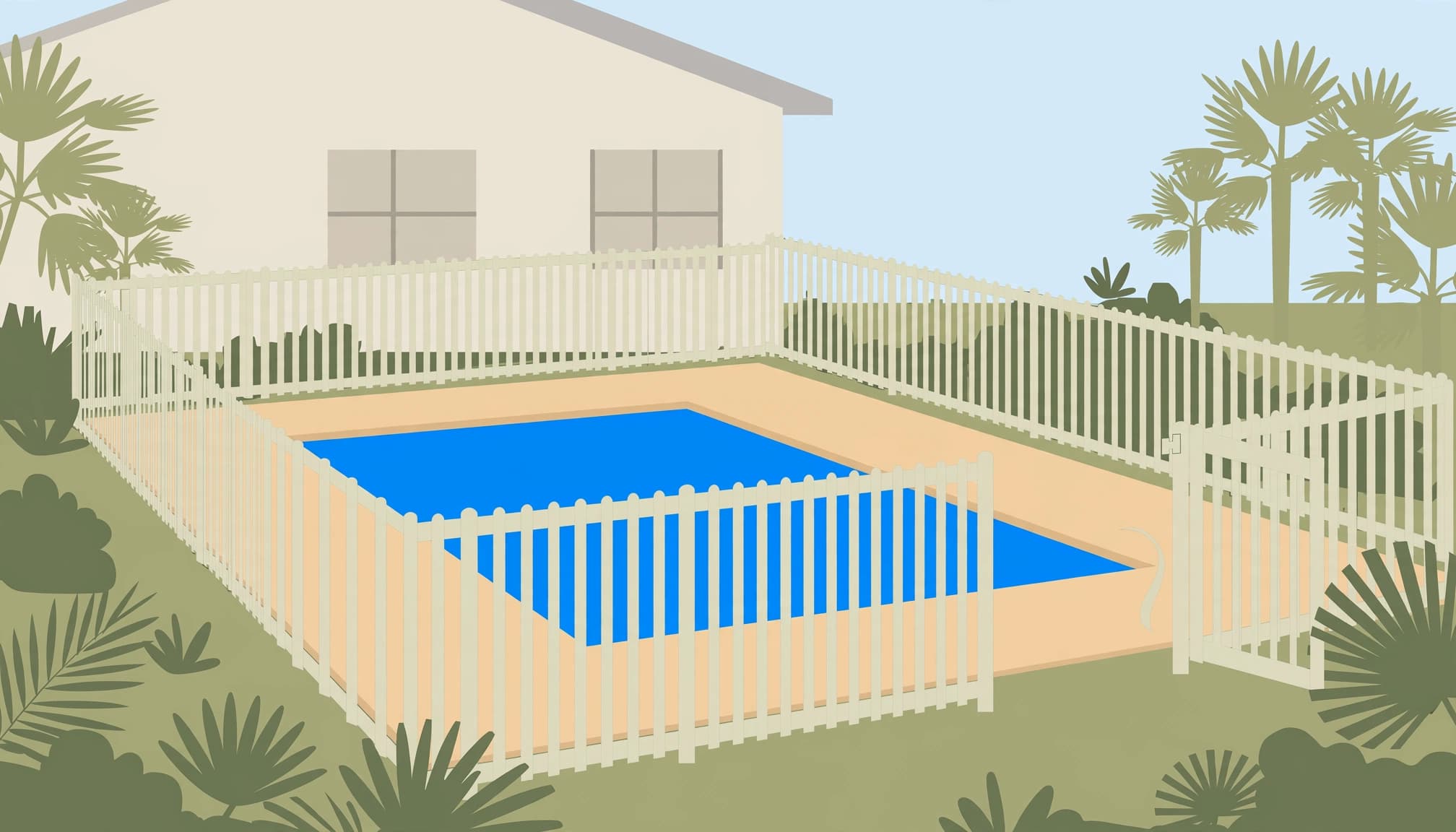
A backyard fence doesn’t automatically qualify as the required isolation enclosure. A pool barrier must separate the pool from the home, not simply surround the property.
Barrier Height, Openings, and Placement
Use these statutory requirements as your barrier checklist:
- The pool barrier must be at least 4 feet high, or 48 inches, on the outside.
- Openings and surface features cannot allow a young child to crawl underneath, squeeze through, or climb over.
- The barrier must surround the pool and sit sufficiently away from the water to prevent an immediate fall.
- A dwelling wall can form part of the barrier only when no door or window opens through it to provide pool access.
A removable mesh fence can qualify when the installed system meets the applicable requirements. Being marketed as a pool fence isn’t enough.
A pool gate must open outward, away from the pool. It must be self-closing and self-latching, with the release on the pool side and beyond a young child’s reach.
An aboveground pool’s structure can function as its barrier. Access ladders or steps must be securable, lockable, or removable, or enclosed by a compliant barrier.
Chapter 515 gives household door releases a 54-inch height requirement. Gate releases have a separate pool-side placement and child-inaccessibility requirement.
Step 2: Choose a Compliant Safety Pool Cover
An approved safety pool cover must meet ASTM F1346-91 performance standards. It can be manually or power operated.
A solar blanket, ordinary tarp, or debris cover doesn’t satisfy this option merely because it covers the water. The selected product must meet the safety standard, and its installation must follow the manufacturer’s requirements.
We recommend retaining the cover’s model information, compliance documentation, installation records, and operating instructions in the property file. These records connect the installed equipment to its stated standard.
For rentals, the daily routine matters. Written instructions should explain when the cover must be secured and how residents report damage. Torn material, loose anchors, or failed operating hardware need prompt attention.
Step 3: Protect Direct Access With Door-Opening Alarms
The exit alarm option applies to all doors and windows that provide direct access from the residence to the pool area. Protecting only the main patio door doesn’t meet this requirement if another qualifying opening remains unprotected.
Each alarm must have a minimum sound-pressure rating of 85 dB(A) at 10 feet. It must sound when a protected door or window opens or is left ajar.
Document every protected opening during installation and at move-in. Keep operating instructions accessible, replace batteries as directed, and address disabled devices promptly.
A general home-security sensor doesn’t automatically meet the exit alarm requirements.
Step 4: Install Self-Closing, Self-Latching Doors
This option requires all doors providing direct home-to-pool access to have self-closing, self-latching devices. The release mechanism must be at least 54 inches above the floor.
A standard lock or latch doesn’t satisfy the option if the door fails to close and latch automatically. Door alignment, closer adjustment, and worn hardware affect whether the system works consistently.
For a rental home, we recommend evaluating the complete door assembly rather than purchasing a latch alone. A compatible closer and properly aligned frame make the equipment more dependable.
Document the door’s operation before move-in and after repairs. Residents should receive clear instructions not to prop the door open or alter the hardware.
Step 5: Consider an Independently Certified Pool Alarm
The fifth statutory option is an in-pool alarm independently certified to ASTM F2208. It must sound upon accidental or unauthorized entry into the water.
Individual-use alarms, such as devices worn by children, don’t qualify. A door-opening alarm detects an opening, while a pool alarm detects entry into the water.
ASTM includes this standard among its consumer product safety standards.
Keep the model number, independent certification documentation for ASTM F2208, and installation instructions with your pool records. For rental planning, consider battery replacement, testing, and reset procedures. An alarm needs a dependable response when it sounds; it doesn’t replace supervision.
Document Approval Before Buying or Leasing
A finished pool can look ready while its permit file remains incomplete. Treat construction approval and equipment condition as separate parts of rental due diligence.
New Construction Approval and Records
Organize the pool permit, approved plans, inspection results, safety-feature documentation, and certificate of completion in one file. The installed feature must meet applicable requirements at final inspection.
Inspection review should cover the selected option’s details, such as barrier height, gate operation, protected openings, door-release height, or product documentation. If an alarm is the selected option, records should establish independent certification to ASTM F2208. An invoice alone doesn’t establish final approval.
Existing Pools and Local Requirements
Chapter 515’s cited safety-feature obligation concerns new pools. The available statutory text doesn’t establish a blanket rule that selling an older home automatically triggers that requirement.
For an existing property, retain records of pool construction, enclosure changes, repairs, and completed permits. Undocumented improvements can complicate a purchase and the rental plan.
Counties and municipalities may adopt stricter rules, including through a county ordinance. A Lee County property and a property within Cape Coral may follow different permitting processes. Verify applicable state and local signage, building, health, and rental requirements with the relevant local authority. Signage rules can depend on pool classification, so don’t assume one rule applies to every pool type.
Build Pool Safety Into Rental Operations
Florida pool safety requirements provide a legal baseline, but equipment needs attention after approval. We recommend making pool access and safety devices part of your inspection and maintenance process.
A Practical Inspection Schedule
Two routine inspections per year are a useful planning baseline for many long-term rentals, not a statewide mandated schedule. Pool homes may need more frequent attention based on condition, equipment, and reported problems.
Include gate closure, latch operation, fence condition, cover hardware, and alarm function in the inspection record. Date photographs and retain repair invoices.
Scheduled visits must respect lawful entry requirements and tenant privacy. Storm damage or a reported equipment failure may require attention before the next routine inspection.
Clear Lease Terms and Insurance Planning
The lease should explain pool-care responsibilities, repair reporting, and restrictions on disabling safety equipment. Written tenant responsibilities don’t excuse an owner from applicable legal duties.
Give residents equipment instructions and a clear way to report problems. Pool cleaning and chemical service don’t automatically include barrier or alarm maintenance.
A rental-appropriate insurance policy should account for tenant occupancy and pool-related liability. Coverage questions belong with an insurance professional; disputes about lease responsibilities or legal duties belong with a qualified Florida attorney.
Understand Penalties and the 45-Day Correction Period
Failing to equip a new residential pool with at least one approved safety feature is a misdemeanor of the second degree.
The statute provides relief if the owner installs a qualifying feature and attends a drowning prevention education program within 45 days after arrest or receiving a summons or notice to appear.
If no program is offered within 45 days after the citation, the attendance requirement is waived. The Florida Department of Health may charge up to $100 for its program.
This correction provision addresses these penalties. It doesn’t erase an unsafe condition’s potential consequences under other laws, an insurance policy, or a civil claim.
We recommend treating a failed safety device as a maintenance priority rather than waiting for enforcement. This article provides general information, not legal advice.
Frequently Asked Questions
What pools are covered by Florida’s Residential Swimming Pool Safety Act?
Chapter 515 covers qualifying detached one- or two-family homes and one-family townhouses no more than three stories high, with pools holding water more than 24 inches deep. The chapter excludes public pools, pools at public lodging establishments, pools at condominium, cooperative, or multifamily buildings, qualifying temporary pools no more than 24 inches deep, and spas with compliant safety covers.
What safety features satisfy the requirement for a new pool?
The options are an isolation barrier, an ASTM F1346-91 safety cover, exit alarms on every direct-access door and window, self-closing and self-latching doors with releases at least 54 inches above the floor, or an in-pool alarm independently certified to ASTM F2208. The selected feature must meet its requirements and pass final inspection.
Does selling a home with an existing pool trigger the new-pool requirement?
Chapter 515’s cited safety-feature requirement concerns new pools, and the cited statutory text doesn’t establish a blanket rule that selling an older home triggers it. Local rules may differ, so check with the relevant county or municipal authority.
What is the 45-day correction period?
An owner cited for failing to equip a new residential pool with an approved feature can qualify for statutory relief by installing one and attending a drowning-prevention education program within 45 days after arrest or receiving a summons or notice to appear. If no program is offered within 45 days after the citation, the attendance requirement is waived, and the Florida Department of Health may charge up to $100 for its program.
Are two pool inspections per year required for rental homes?
No. Two routine inspections per year are a planning baseline for many long-term rentals, not a statewide mandated schedule. A pool may need more frequent attention based on its condition, equipment, or reported problems.
Protect Your Rental With Dependable Pool Safety
The strongest pool-safety plan combines an approved feature with reliable upkeep and complete property records. Final approval matters, but the equipment must continue working throughout the tenancy.
We help owners organize inspections and maintenance coordination as part of dependable rental management. You can discuss your rental management needs with our team.
A well-maintained pool safety system supports resident safety and the long-term care of your investment.