

To calculate a Florida rental cap rate, divide annual net operating income by the purchase price, then multiply by 100. The result measures the property’s income yield before financing, so it doesn’t tell you what remains after mortgage payments.
We recommend building the operating budget first, because Florida insurance, property taxes, and maintenance can change an investment’s appeal. Start with the formula, then work through the costs behind it.
Key Takeaways
- Calculate cap rate using annual NOI, not gross rent or income after mortgage payments.
- Base Florida expenses on the property itself, including post-purchase taxes, insurance, and management.
- Use cap rate alongside cash flow, growth assumptions, and a conservative resale analysis.
Calculate a Florida Rental Cap Rate
Apply the Cap Rate Formula
The formula is:
Cap rate = annual NOI ÷ purchase price × 100
For example, $80,000 in NOI divided by a $1,000,000 purchase price equals an 8% cap rate.
NOI means net operating income: effective property income minus operating expenses. It excludes mortgage principal and interest, depreciation, and personal income taxes. Under the before-reserve convention used here, planned capital reserves also sit below NOI.
For an existing holding, dividing NOI by current market value measures the property’s current yield. Dividing by the original purchase price answers a different question.
Build NOI Before Dividing
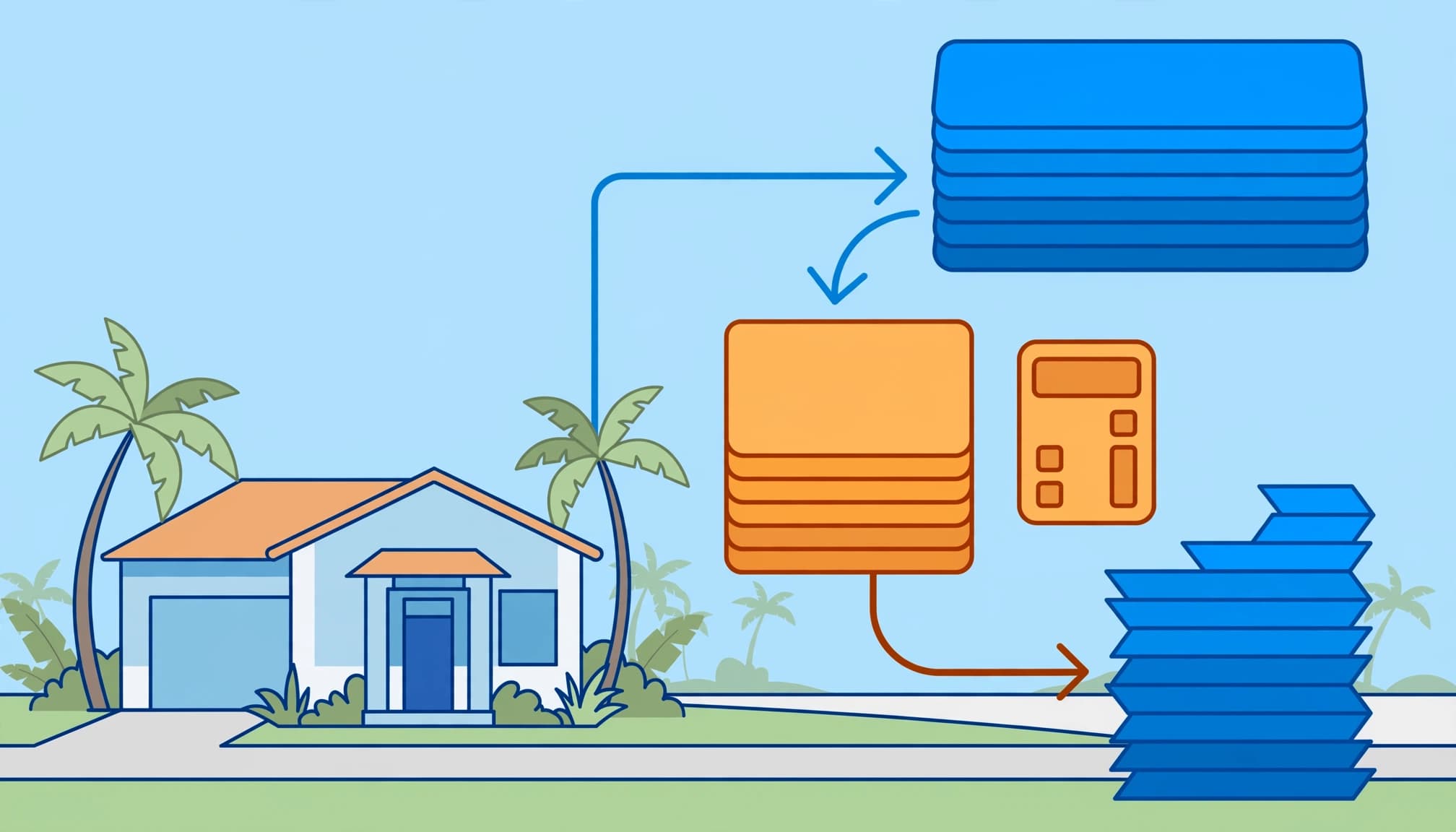
Begin with scheduled annual rent, subtract vacancy and unpaid-rent allowances, then add other recurring property income. Next, subtract operating expenses.
The following underwriting illustration uses projected income rather than a market rent forecast. It provides totals, but doesn’t break out scheduled rent, vacancy, unpaid rent, recurring income, or individual operating expenses such as taxes, insurance, HOA dues, management, and routine maintenance.
| Calculation Item | Annual Amount |
|---|---|
| Scheduled rent, vacancy and unpaid-rent deductions, and recurring property income | Not itemized |
| Effective rent after vacancy | $21,090 |
| Operating expenses, total | $12,464 |
| Net operating income | $8,626 |
| Purchase price | $329,000 |
| Cap rate | 2.62% |
The calculation is $8,626 ÷ $329,000 × 100 = approximately 2.62%.
That yield is substantially lower than a gross-rent calculation would suggest. However, it still excludes financing and planned reserves, which we’ll account for separately.
Include the Florida Costs That Affect NOI
Use Post-Purchase Taxes and Address-Specific Insurance
We recommend modeling the property’s likely post-purchase tax burden rather than carrying forward the seller’s bill. A change in ownership can affect assessed value, and the seller’s homestead benefits generally won’t apply to an investment rental.
Insurance needs its own analysis. Roof condition, construction, replacement cost, wind exposure, and flood exposure can affect the expense. Include separate flood coverage where applicable, rather than assuming standard property insurance covers flooding.
Closing tax prorations allocate an existing bill. They don’t preserve the seller’s future assessment or exemptions.
Separate Routine Expenses From Capital Reserves
Operating expenses include management and leasing costs, routine repairs, HOA dues, owner-paid utilities, lawn care, and pool service. Turnover and required inspections also belong in the budget when applicable.
Investors should apply a property-specific vacancy rate to reduce income, rather than book vacancy as a repair expense. The Census Bureau’s housing vacancy statistics provide broad context, but an individual property’s allowance should reflect its leasing conditions and turnover exposure.
Roof replacements and major HVAC work need separate capital planning. We keep those reserves below NOI in this calculation and use the same convention across comparisons.
A before-reserve cap rate and an after-reserve cap rate aren’t directly comparable. The expense treatment must match before the percentages mean anything.
Use Cap Rate to Estimate Property Value
The formula also works backward:
Estimated value = annual NOI ÷ market cap rate
For example, $60,000 in NOI divided by a 6% market cap rate implies a $1,000,000 value. Enter 6% as 0.06 when calculating.
This relationship helps translate operating performance into a price estimate. However, the market cap rate must come from comparable properties with similar locations, condition, and income stability.
A rental house in Lehigh Acres and an institutional apartment community aren’t interchangeable comparisons.
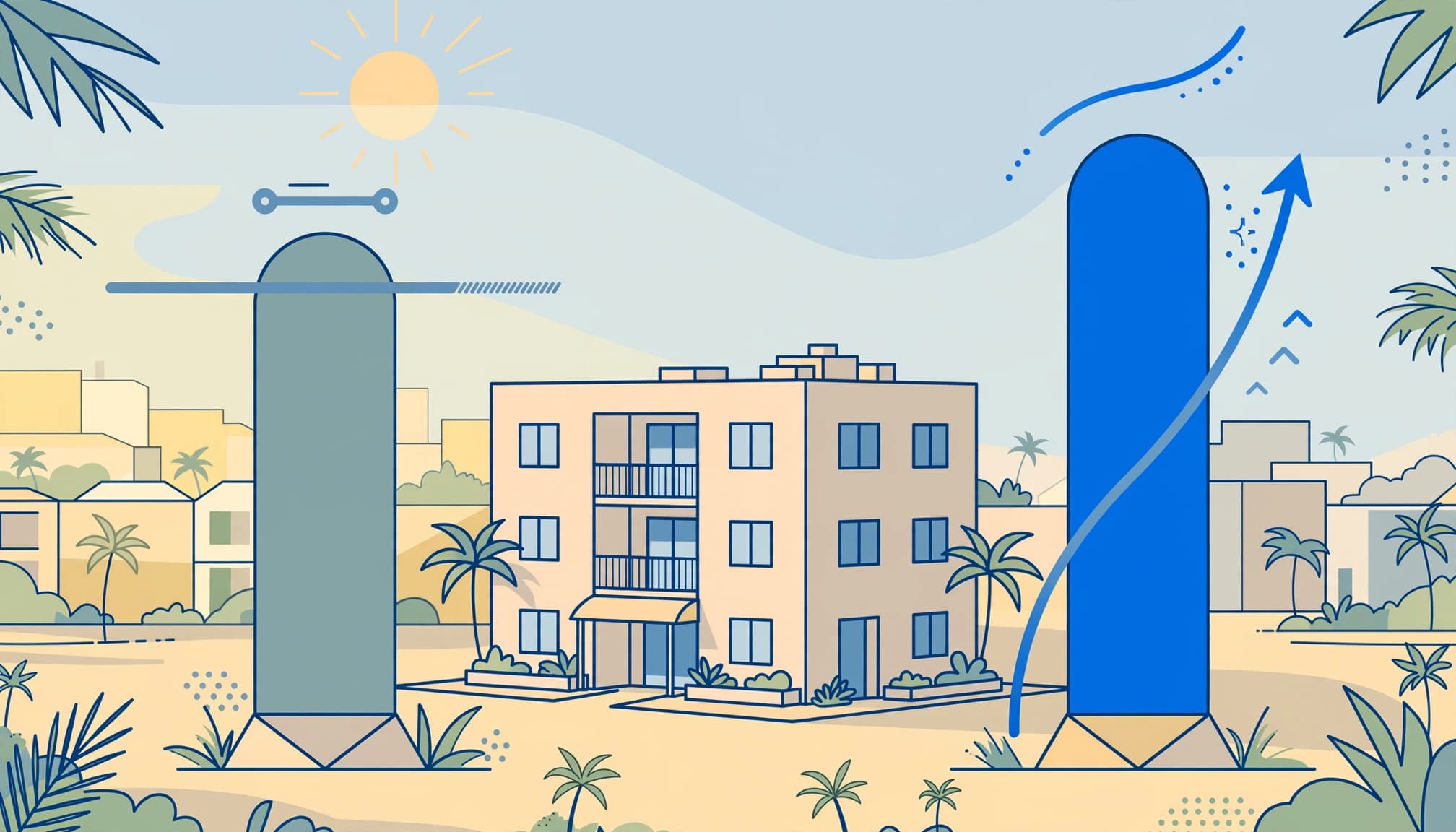
At a constant 6% cap rate, each additional dollar of sustainable annual NOI supports approximately $16.67 in value. Therefore, reducing recurring expenses can increase estimated value just as higher rent can.
Understand How Growth and Required Return Interact
Connect Cap Rates With Long-Term Growth
Direct capitalization resembles a no-growth perpetuity: stable annual income divided by the required return estimates value.
A growing perpetuity adjusts that relationship:
Value = next year’s income ÷ (required return minus growth)
A $1,000 annual income stream, a 4% required return, and 2% perpetual growth produce a $50,000 value. This simplified model requires constant growth below the required return.
Origin Investments’ educational guide describes contractual rent growth of roughly 1% to 3% annually. It also describes market rent changes ranging around negative 5% to positive 10%, with 2% to 4% averages in markets with strong employment and population growth.
Those ranges aren’t Florida rent forecasts. Short residential leases also don’t guarantee years of increases.
Distinguish Required Return From Cap Rate
We view required return as roughly a risk-free rate benchmark plus compensation for property risk. The 10-year Treasury is a common reference, available through the Treasury’s official interest-rate statistics.
If Treasuries yield 4%, investors generally require more than 4% total return for a riskier property. However, the operating yield can fall below that required return when investors expect NOI growth.
Higher interest rates can push required returns upward. Unless growth expectations improve, that pressure can raise cap rates and reduce values.
Judge a Good Cap Rate by the Property’s Risk
There isn’t one good Florida rental cap rate for every investment. We compare the yield with income stability, property condition, and achievable growth.
A longer lease term and stronger tenant reliability can support a lower cap rate because income is more dependable. Weaker tenant credit or uncertain renewals may require a higher yield. A long lease at below-market rent can still limit near-term income growth.
Cap rate measures operating yield, not the complete expected return. Financing, reserves, and future value also affect the investor’s result.
Replacement cost matters too. A property priced above the cost of comparable new construction faces competition if builders can add supply easily. Investors may require a higher cap rate to compensate.
Likewise, location affects leasing demand and resale options. We wouldn’t evaluate Cape Coral and Lake Placid rentals using an identical market assumption simply because both are in Florida.
A higher percentage deserves an explanation. It can reflect opportunity, deferred maintenance, unreliable income, or several of these together.
Put Reported 2026 Cap Rates in Context
Apartment Loan Store reports these Q2 2026 commercial averages.
| Property Type | Reported Average Cap Rate |
|---|---|
| Multifamily | 5.2% |
| Industrial | 5.2% |
| Retail | 6.7% |
| Office | 7.9% |
| Hotels | 7.5% |
These commercial real estate figures are broad sector references, not Florida rental-house benchmarks or recommended purchase yields.
Its hospitality discussion separately reports an 8.5% average, approximately 5.5% for upscale properties in large markets, and 8.5% to 11% for lower-quality tertiary assets. The hotel and hospitality figures shouldn’t be combined into one reconciled average.
For residential investors, property type and asset quality affect pricing. Compare properties of similar types and quality, such as Class A apartments with other Class A assets. Reported multifamily cap rates don’t establish the right yield for an individual house, duplex, or small apartment building.
Stress-Test Income and the Exit Cap Rate
Cap rates work best with stabilized income, meaning a sustainable operating level rather than temporary occupancy or projected renovations.
A stated 15% cap rate can mislead when collections fluctuate or major repairs interrupt operations. For uneven income, a discounted cash flow analysis can better account for when income and expenses occur.
Cap rate compression means cap rates fall. When NOI also rises, both changes push value upward. Cap rate expansion means cap rates rise, reducing value if NOI stays constant.
Compare the acquisition’s going-in cap rate with your modeled exit cap rate, then test a higher resale assumption. For example, when stabilized market caps are around 5%, a 5.5% to 6.0% exit cap rate tests a less favorable resale environment.
Run conservative, expected, and stronger cases. Vary vacancy and operating costs as well as rent, because attractive resale assumptions won’t cover an annual operating shortfall.
Frequently Asked Questions
How Is Cap Rate Different From Cash Flow?
Cap rate measures operating yield before financing. Cash flow subtracts annual debt service and planned reserves from NOI.
Using the earlier illustration, $8,626 in NOI minus approximately $19,704 in annual debt service and a $1,055 reserve produces roughly negative $12,133 in annual pre-tax cash flow. Therefore, a positive cap rate doesn’t guarantee positive monthly cash flow.
Should Purchase Costs Be Included in the Denominator?
The standard purchase cap rate uses the purchase price. An all-in yield calculation can include closing costs and initial improvements, but label it separately.
We recommend showing both when acquisition costs are substantial. Otherwise, two investments can appear equally productive even though one requires much more upfront cash.
Is Buying Rental Property in Florida a Good Idea?
It can be when achievable income supports ownership costs, financing, and future replacements. Location alone doesn’t establish investment quality.
We recommend comparing properties under consistent assumptions and separating tax benefits from operating performance. A deal that requires perfect occupancy and aggressive rent growth offers less room for unexpected expenses.
Make the Operating Budget Drive the Decision
A useful Florida rental cap rate starts with dependable NOI, not the highest advertised rent. Build the expense budget first, then compare the resulting yield with similar properties and their risks.
Next, calculate cash flow after debt service and reserves. Stress-test the resale assumptions before deciding what to pay.
At Best Investing Realty, we help investors connect rental analysis with property management and local operating needs. Your purchase decision should rest on income the property can sustain.