

Two homes can have similar list prices and produce very different returns. When we compare rental properties in Southwest Florida, we look past advertised rent. We review insurance, taxes, maintenance, flood exposure, tenant demand, financing, and property management together.
That matters in Cape Coral, Fort Myers, Lehigh Acres, Port Charlotte, Punta Gorda, and Lake Placid. Local market insights help owners and real estate investors choose properties for a rental portfolio. Compare investment properties conservatively; the strongest choice isn’t always the lowest-priced home, especially when rent slows or an expensive repair arrives.
Key Takeaways
- Compare every candidate using the same property profile, rent assumptions, operating expenses, financing terms, and reserve requirements.
- Verify achievable rent with local rental comps and recent leased homes instead of relying only on automated estimates or advertised listings.
- Calculate NOI and cash flow after accounting for vacancy, insurance, taxes, HOA dues, maintenance, property management, and replacement reserves.
- Check location-specific risks, including flood exposure, wind and flood insurance, reassessment risk, HOA restrictions, and maintenance-heavy features such as pools or seawalls.
- Choose the property that remains practical under conservative assumptions and fits the likely tenant pool and management plan—not necessarily the one with the lowest purchase price.
Create a Consistent Profile for Every Candidate
Before evaluating each candidate, we create the same profile for every property. Standardized inputs support a repeatable rental market analysis and consistent selections for a rental portfolio.
Start With the Same Property Profile
Use the same rental property data fields for every candidate, including purchase costs, physical features, HOA fees, leasing restrictions, condition, and projected property management costs. Record the address, purchase price, closing costs, bedrooms, bathrooms, square footage, year built, parking, pool, waterfront access, repair needs, and furnishing requirements. Record the original listing source, then remove duplicate feed entries created through listing syndication.
Use rental comps to compare like-for-like homes whenever possible. Single-family homes shouldn’t automatically be compared with unlike assets. Location, school access, commute times, flood exposure, and outdoor features all affect comparability and the tenant pool.
We also check whether each property suits long-term leasing, seasonal occupancy, or another approved rental strategy. HOA documents, municipal requirements, and lease restrictions should be reviewed before making an offer.
Set an Achievable Rent Range
Automated rent estimates usually review nearby listings and adjust for bedrooms, bathrooms, square footage, property type, location, and amenities. They provide a useful starting point, but they don’t always show the rent a qualified tenant will actually pay.
We compare active listings with recently leased homes, then account for condition, days on market, price reductions, concessions, and seasonal demand. A practical analysis includes conservative, expected, and strong rent estimates. Tie each scenario to a competitive rent price and nearby rental rates, not the most optimistic projection.

Build the Financial Comparison Before You Tour
A property can look appealing during a showing and still produce weak returns. We begin the financial comparison before becoming attached to the finishes, view, or asking price.
Calculate NOI and Cash Flow
Start with annual gross rent by multiplying expected monthly rental income by 12. Then subtract vacancy and credit loss, owner-paid utilities, concessions, and other income adjustments.
Operating expenses usually include property taxes, insurance, HOA dues, property management fees, lawn care, pool service, pest control, routine repairs, turnover costs, and replacement reserves. The result is net operating income, or NOI, before mortgage payments.
Real estate investors should apply the same assumptions to every property in a rental portfolio, making results easier to compare.
Cap rate is calculated by dividing NOI by the purchase price or total acquisition cost. Cash flow goes one step further by subtracting debt service and planned reserves from NOI.
| Comparison Line | What to Review | Why It Matters |
|---|---|---|
| Rent | Achievable monthly range | Sets income expectations |
| Expenses | Taxes, insurance, repairs, and management | Shows the true cost of ownership |
| NOI | Income before financing | Supports cap-rate analysis |
| Cash flow | NOI less debt service and reserves | Shows monthly investment performance |
Include the Costs That Follow the Property
Use actual insurance quotes and current tax records when possible. A small difference in annual insurance or taxes can reduce returns more than a slightly higher rent can improve them.
We also model vacancy and repairs separately. Vacancy affects income, while repairs affect expenses, and combining them into one rough percentage can hide the property’s actual risk. New construction may reduce early repair needs, but it doesn’t remove insurance, taxes, landscaping, or future replacement costs.
A higher rent estimate doesn’t make a better investment if insurance, maintenance, and vacancy consume the difference.
Read Southwest Florida Rental Market Data Correctly
Southwest Florida rental market data can vary by platform. Each service may use different property types, listing sources, sample sizes, and time periods, while tracking active asking rents or signed leases. We use those figures directionally, then validate them with property-level rental comps through a local rental market analysis.
Compare Rental Comps by City and Property Type
Citywide rental rates provide context, but rental property data from similar homes is more useful for underwriting. Compare single-family homes by neighborhood, size, and lease type to assess whether the property has a competitive rent price.
As of August 2026, the first three rows show platform estimates from advertised active listings, using median or trend calculations. Reliable current figures weren’t available for the other markets, so those rows are marked accordingly. Verify every figure against its source date and sample before relying on it.
| Market | Current Rental Signal | Recent Trend |
|---|---|---|
| Cape Coral | August 2026 platform estimate from advertised active listings: about $1,850 median overall, with houses near $2,100 | August 2026 platform change: down 5.1% year over year |
| Fort Myers | August 2026 platform estimate from advertised active listings: about $1,900 median rent | August 2026 platform change: down 9.5% year over year, up 1% month over month |
| Lehigh Acres | August 2026 platform estimate from advertised active listings: about $1,780 median rent | August 2026 platform change: down 6.3% year over year |
| Port Charlotte | Reliable current local estimate unavailable as of August 2026 | Verify by home type and neighborhood |
| Punta Gorda | Reliable current local estimate unavailable as of August 2026 | Verify by home type and neighborhood |
| Lake Placid | Reliable current local estimate unavailable as of August 2026 | Verify by home type and neighborhood |
The available figures are platform estimates, not official government statistics. Listing syndication can duplicate or distort active listing counts, while premium placement can influence visibility without proving demand. Zillow has placed Cape Coral’s average rent near $2,000, while other listing services show different values based on apartments, houses, sample sizes, and available inventory.
For a broader statewide reference, review Florida housing and rental market trends and a 2026 Florida market overview. The first source is a real estate website, and both provide useful market insights. Neither replaces local rental comps, so local real estate professionals should confirm neighborhood-level conditions.
Track Trends Without Overreading Them
One month of data doesn’t establish a reliable investment trend. Review at least six to twelve months when possible. Compare historical rent trends with rent changes, available inventory, price reductions, days on market, and renewal behavior.
Recent rent declines in Cape Coral and Fort Myers make conservative underwriting especially important for real estate investors. Historical rent trends can help you identify neighborhoods where demand is stable, but past growth shouldn’t be treated as guaranteed future income.
The best comparison uses a range. If Property A only works at the highest projected rent while Property B remains profitable at a lower rent, Property B may offer greater protection.
Check the Costs That Change by Location
Location affects more than purchase price. For each address, verify flood exposure, wind coverage, taxes, HOA rules, and maintenance needs. Coordinate with real estate professionals, insurance agents, inspectors, appraisers, or other qualified local advisers when details are unclear. These differences can compound across a rental portfolio.
Confirm Flood, Insurance, and Tax Exposure
Search each address through FEMA’s Flood Map Service Center. Record the flood zone, effective map date, and applicable map panel for each property. Don’t rely on an old listing description when requesting current wind and flood insurance quotes.
FEMA considers areas with a 1% annual chance of flooding or higher to be high-risk areas. Over a 30-year mortgage, that equals at least a one-in-four chance of flooding. Flood insurance is separate from standard property coverage, so obtain current quotes for flood and wind exposure.
Florida Statute 83.512 requires a separate written flood disclosure for prospective tenants before qualifying leases of one year or longer are executed. The disclosure addresses known flooding, prior flood claims, and federal flood assistance, while renters insurance generally doesn’t cover flood damage. Review the Florida flood disclosure statute and seek professional legal advice to confirm current wording and lease compliance.
For tax history, exemptions, current assessments, and reassessment risk, review property records through the Lee County Property Appraiser. Check Port Charlotte and Punta Gorda through the Charlotte County Property Appraiser, and Lake Placid through the Highlands County Property Appraiser.
Price Features Against Maintenance
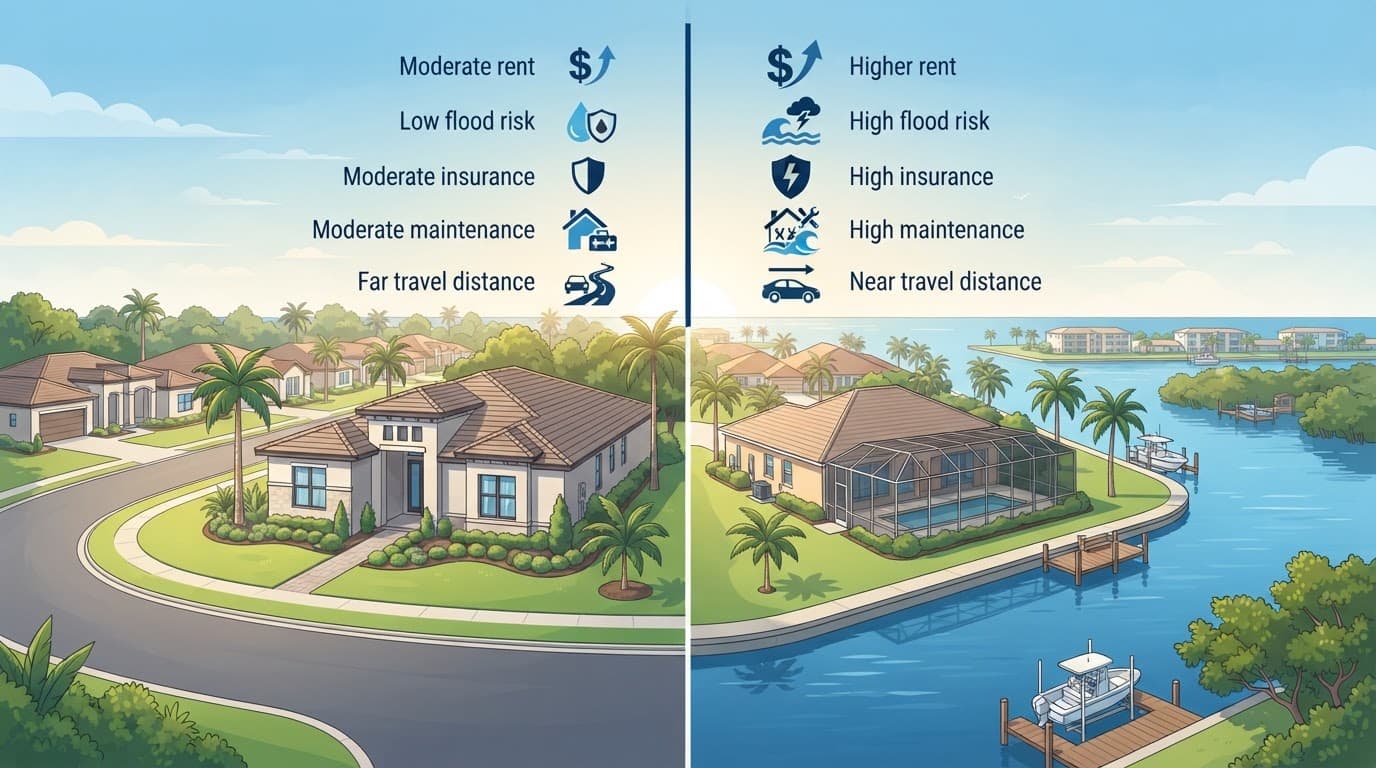
Cape Coral homes with gulf access, canal views, private pools, screened outdoor areas, or updated kitchens may attract more attention. Estimate the rent premium from these features by comparing local rental rates with ongoing maintenance and replacement costs.
Waterfront properties can require seawall, dock, irrigation, insurance, and storm-preparation expenses. Pool homes need regular cleaning, equipment inspections, and prompt repairs. Ask the property management team or service provider to price and coordinate recurring pool, lawn, pest, seawall, and storm-related work. A feature is an advantage only when its added income justifies those costs.
Match Tenant Demand With the Management Plan
Real estate investors building a rental portfolio should evaluate each home’s likely tenant pool and the support needed to operate it. The strongest investment is easier to manage when the home fits likely renters and the owner’s available support.
Look at the Tenant Pool, Not Only the Home
Consider commute routes, nearby employment, schools, shopping, medical facilities, pet policies, parking, storage, and outdoor space. A flexible pet policy and practical amenities can expand demand for single-family homes, but an overpriced home can create vacancy. Set a competitive rent price by reviewing nearby listings and rental rates.
We also review the condition of appliances, air conditioning, plumbing, roof, windows, and landscaping. Florida’s climate puts extra pressure on cooling systems, exterior finishes, lawns, and pest control. A property with lower rent but fewer maintenance demands can outperform a more expensive home with frequent service calls.
Use Listing and Screening Tools With Care
Tools such as Rentometer and RentCast can support rent estimates and rental comps. Rental listing platforms such as Avail and Zillow Rental Manager support listing, tenant screening, and rent collection, while Mashvisor focuses on investment analysis. These tools support local judgment and property-level verification, but software doesn’t replace property management.
Basic plans may be free, while paid property management services often cost roughly $5 to $69 per month. Pricing changes frequently, so verify current fees before choosing a plan, and check whether separate tenant screening fees apply.
Free listing syndication can place a rental on multiple rental listing platforms. Check listing syndication feeds for duplicate details and track listing syndication results by source. Paid premium placement can improve visibility, but it doesn’t guarantee a qualified tenant. Compare rental listing platforms by lead quality, rental applications received, vacancy days, and total cost. Test premium placement costs against results before upgrading, and use premium placement only when results justify it.
Many listing platforms allow landlords to order credit, background checks, and eviction-history reports directly. Applicants should authorize tenant screening reports, and landlords should protect their privacy. Apply tenant screening standards consistently, document the criteria, and follow fair-housing requirements. We typically review rental applications, recent pay stubs, bank statements, tax returns, job offer letters, other income documentation, rental history, and landlord references when appropriate.
A written property management plan should cover rent collection, accounting, inspections, maintenance coordination, and legal compliance. The plan should address record keeping for rental applications. It should define the management workflow for tenant screening, listing syndication, and premium placement. At Best Investing Realty, these property management services help owners stay informed. Tenants receive a reliable way to submit maintenance requests and access documents, payments, and updates.
Frequently Asked Questions
What is the most important factor when comparing rental properties?
Achievable rent should be evaluated together with the property’s full operating costs and risks. A lower-priced home may produce weaker returns if insurance, taxes, maintenance, vacancy, or management costs are higher.
How should I estimate rent for a Southwest Florida rental property?
Compare similar active listings with recently leased homes in the same neighborhood and property type. Use conservative, expected, and strong rent scenarios while considering condition, concessions, days on market, and seasonal demand.
What expenses should be included in a rental property comparison?
Include vacancy and credit loss, property taxes, insurance, HOA dues, property management, utilities, lawn and pool care, pest control, repairs, turnover costs, and replacement reserves. Calculate NOI before mortgage payments, then calculate cash flow after debt service and planned reserves.
Why do flood and insurance checks matter in Southwest Florida?
Flood exposure, wind coverage, and separate flood insurance can materially change a property’s operating costs and investment risk. Verify the address through FEMA’s Flood Map Service Center and obtain current insurance quotes instead of relying on old listing information.
Should rental investors use software to compare properties and screen tenants?
Tools such as Rentometer, RentCast, and Mashvisor can support rent estimates, rental comps, and investment analysis. They should supplement local verification and a written property management plan, while tenant screening must be consistent, documented, and compliant with fair-housing requirements.
Conclusion: Choose the Stronger Rental, Not the Cheapest One
For real estate investors, compare rental properties using the same assumptions for every home. Verify rent with local comparable listings and model overlooked costs consistently across your rental portfolio. Flood exposure, insurance, taxes, maintenance, tenant demand, and management requirements deserve the same attention as purchase price and monthly rent.
The right property remains practical under conservative assumptions. When the numbers are close, local market insights, experienced property management, and advice from real estate professionals can clarify the tradeoffs without guaranteeing performance. These resources inform the decision, but conservative underwriting should determine whether the rental fits your portfolio.